

Agentic RAG
Retrieval-Augmented Generation with autonomous reasoning, multi-step planning, and iterative tool use — explained with examples and visual flows.
What is Agentic RAG?
Standard RAG retrieves documents once and generates an answer. Agentic RAG goes further — the LLM acts as an autonomous agent that plans, decides what to retrieve, evaluates quality, and iterates until it has a satisfactory answer.
Instead of a single fixed pipeline, the agent can use multiple tools, reformulate queries, retrieve from diverse sources, and reflect on its own outputs.
Standard Approach
- Single retrieval step — fixed query
- Top-k chunks → immediate answer
- No feedback loop or self-evaluation
- Cannot use external tools or APIs
- Fails on complex, multi-hop questions
Autonomous Approach
- Multi-step reasoning and planning
- Dynamically reformulates queries
- Self-evaluates and retries if needed
- Uses diverse tools: web, SQL, APIs
- Handles complex, multi-hop questions
How It Works
The agent follows a dynamic loop — planning, retrieving, reasoning, and deciding whether to answer or dig deeper.
The user submits a natural language question or task. The agent receives full context including conversation history and available tools.
The LLM analyzes the query: Is it multi-hop? Which sources are relevant? It decomposes complex questions into sub-questions and forms a retrieval plan.
The agent selects and calls tools — vector DB, keyword search, SQL, web search, APIs. Each call returns documents or structured data relevant to sub-queries.
The LLM reads retrieved context, extracts relevant facts, resolves conflicts across sources, and synthesizes intermediate answers for each sub-question.
Once the agent is confident in coverage and accuracy, it generates the final answer with citations pointing back to retrieved sources.
Real-World Use Cases
See how Agentic RAG solves complex questions that basic RAG cannot handle in a single pass.
Answering a complex contract clause question spanning multiple documents and jurisdictions.
- ① Decomposes into clause + case law sub-queries
- ② Searches internal docs + legal DB
- ③ Retrieves precedent cases from API
- ④ Cross-references jurisdiction rules
- ⑤ Synthesizes cited legal answer
“Compare Q3 performance vs competitors and explain the revenue gap.”
- ① Identifies company + competitors
- ② Queries internal SQL for Q3 data
- ③ Web-searches competitor filings
- ④ Computes delta, detects gap causes
- ⑤ Outputs structured comparison report
Clinician asks about treatment options for a patient with comorbidities and drug allergies.
- ① Parses patient profile sub-queries
- ② Retrieves clinical guidelines
- ③ Checks drug interaction database
- ④ Filters by allergy contraindications
- ⑤ Returns ranked, safe options
“How do I integrate auth with our custom middleware in v3?”
- ① Identifies version + component
- ② Searches versioned docs + changelogs
- ③ Fetches code examples from GitHub
- ④ Checks for breaking changes
- ⑤ Returns working code snippet
Tracking product launches, pricing changes, and sentiment across the web in real-time.
- ① Identifies competitors + signals
- ② Web-searches press releases, blogs
- ③ Queries social sentiment API
- ④ Resolves conflicting info
- ⑤ Delivers structured intel brief
“Summarize recent findings on transformer efficiency vs performance trade-offs.”
- ① Scopes topic + date range
- ② Queries paper databases
- ③ Retrieves abstracts + methods
- ④ Identifies consensus & debates
- ⑤ Generates cited literature summary
Key Building Blocks
Agentic RAG systems are composed of several specialized modules working in concert.
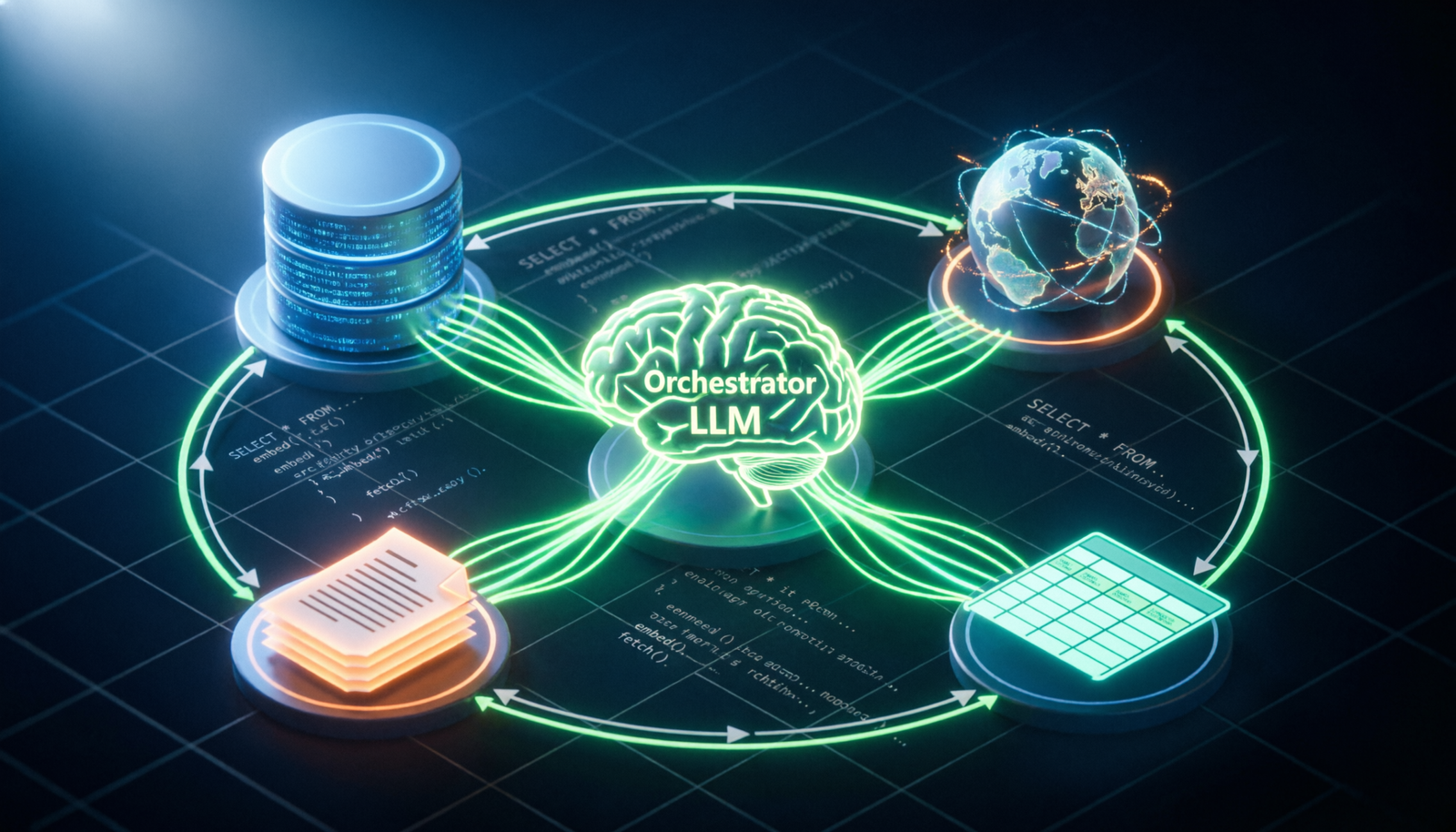
Orchestrator LLM
The reasoning core. Plans retrieval steps, evaluates results, decides when to iterate, and generates the final answer.
Vector Store
Stores embedded document chunks. Enables semantic similarity search beyond keyword matching.
Tool Registry
A set of callable tools: search APIs, SQL databases, calculators, web browsers, custom endpoints.
Query Rewriter
Reformulates user queries and sub-queries for better retrieval precision. Runs HyDE or step-back prompting.
Relevance Grader
Scores retrieved chunks. Filters out irrelevant documents before passing context to the LLM.
Memory / State
Maintains conversation context, sub-answers, and visited sources across the multi-step loop.