

Designing Directed
Acyclic Graphs
for Complex Tasks
A structured guide to modeling workflows, dependencies, and execution pipelines using DAGs — from first principles to production patterns.
What is a Directed Acyclic Graph?
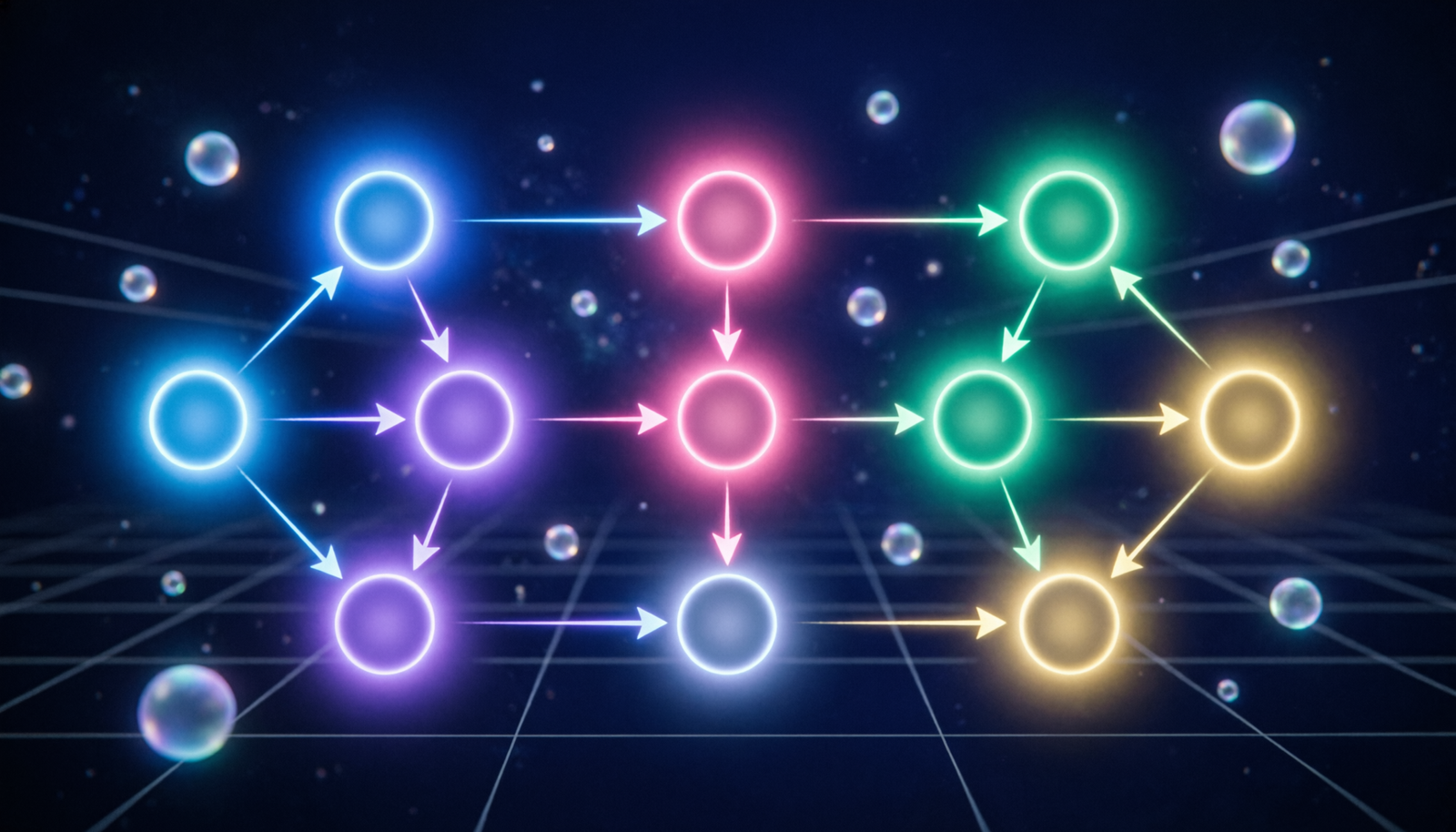
A Directed Acyclic Graph is a graph of nodes connected by directed edges, with one critical constraint: no cycles. You can follow edges forward, but you’ll never loop back to where you started. This property makes DAGs ideal for representing dependency chains, task pipelines, and causal flows.
Every DAG has a topological ordering — a way to sequence all nodes so that every edge points from earlier to later. This ordering is the backbone of deterministic execution: it tells you exactly what must run before what.
Directed Edges
Each edge encodes a dependency: task B depends on task A means there’s a directed edge from A → B. Direction carries semantic meaning about information or control flow.
No Cycles
The acyclic constraint prevents deadlock and infinite loops. If A depends on B and B depends on A, neither can start — a cycle is a deadlock by definition.
Topological Order
Every DAG admits at least one topological sort. This total ordering lets executors schedule tasks in a valid sequence respecting all upstream dependencies.
Parallelism
Nodes at the same topological level have no dependencies on each other and can execute in parallel, turning a sequential list into a concurrent execution plan.
Six Principles for Well-Designed DAGs
Good DAG design is not just about getting the graph right — it’s about expressing the problem’s true dependency structure clearly, minimizing unnecessary coupling, and enabling efficient execution.
Minimize fan-in at critical nodes
Nodes with many upstream dependencies become bottlenecks. If a node waits for 12 upstream tasks, it serializes your pipeline. Redesign fan-in nodes to accept partial results or split them into independent sub-tasks.
Maximize parallelism at each level
Group independent tasks at the same topological depth. When designing, ask: “Do tasks A and B really depend on each other, or am I just ordering them out of habit?” If truly independent, make them siblings.
Keep edge semantics consistent
Edges can mean “provides data to”, “must complete before”, or “triggers”. Pick one semantic per graph and be strict. Mixing data-flow and control-flow edges in the same DAG creates confusion and hidden coupling.
Prefer narrow contracts between nodes
Each node should consume only what it needs from upstream. Wide interfaces — where a node depends on the entire output of upstream — create fragile coupling. Pass only the minimal slice of data needed.
Design for partial failure and retry
When a node fails mid-pipeline, which upstream nodes need to re-run? Idempotent nodes can be safely retried. Mark nodes as idempotent or stateful in your design so executors know which checkpoints to restore from.
Validate acyclicity at design time
Don’t rely on the runtime to catch cycles. Use topological sort (Kahn’s algorithm or DFS-based) as a build-time check whenever the graph definition changes. A cycle discovered in production is always costlier than one caught at compile time.
Common DAG Patterns
Real pipelines are assembled from a small vocabulary of recurring sub-graph shapes. Recognizing these patterns lets you reason about performance, failure modes, and scheduling at a glance.
Linear Chain
Sequential tasks with no parallelism. Simple to reason about but fully serial — each stage waits for the previous.
Fork–Join
One node fans out to parallel workers; a join node aggregates results. Classic MapReduce topology for embarrassingly parallel workloads.
Multi-Source Merge
Multiple independent sources converge into a single downstream task. Common in ETL pipelines where data from several origins must be reconciled.
Broadcast Pipeline
Each stage fans out independently to the next, maintaining separate streams. Used when each fork represents a distinct output channel or consumer.
Diamond (Skip-Level)
A source fans out, some paths merge, and others bypass intermediate nodes. Introduces cross-level edges — common in dependency resolution systems.
Staged Fan-in
Multiple parallel branches, each independently assembled before merging. Enables phased computation where related tasks are grouped before aggregation.
Building a DAG Executor in Python
A minimal DAG executor needs three things: a representation of nodes and edges, a topological sort, and a scheduler that respects the ordering. Below is a clean, idiomatic implementation using Kahn’s algorithm.
# dag_executor.py — minimal DAG scheduler
from collections import defaultdict, deque
from typing import Callable, Any
import concurrent.futures

class DAG:
    def __init__(self):
        self.nodes: dict[str, Callable] = {}
        self.edges: dict[str, list[str]] = defaultdict(list)
        self.in_degree: dict[str, int] = defaultdict(int)

    def add_node(self, name: str, fn: Callable) -> None:
        self.nodes[name] = fn
        if name not in self.in_degree:
            self.in_degree[name] = 0

    def add_edge(self, src: str, dst: str) -> None:
        self.edges[src].append(dst)
        self.in_degree[dst] += 1

    def topological_sort(self) -> list[str]:
        """Kahn's algorithm — raises ValueError if cycle detected."""
        q = deque(n for n, d in self.in_degree.items() if d == 0)
        order, deg = [], dict(self.in_degree)
        while q:
            n = q.popleft()
            order.append(n)
            for child in self.edges[n]:
                deg[child] -= 1
                if deg[child] == 0: q.append(child)
        if len(order) != len(self.nodes):
            raise ValueError("Cycle detected — not a valid DAG")
        return order

    def execute(self, inputs: dict[str, Any]) -> dict[str, Any]:
        order = self.topological_sort()
        results = {**inputs}
        for name in order:
            if name in self.nodes:
                results[name] = self.nodes[name](results)
        return results

# Usage
dag = DAG()
dag.add_node("parse",     lambda r: parse_input(r["raw"]))
dag.add_node("validate",  lambda r: validate(r["parse"]))
dag.add_node("transform", lambda r: transform(r["validate"]))
dag.add_edge("parse", "validate")
dag.add_edge("validate", "transform")

output = dag.execute({"raw": load_data()})
Where DAGs Power Real Systems
DAGs are the hidden skeleton of modern data infrastructure. Nearly every large-scale task orchestration system is, at its core, a DAG scheduler with extra features layered on top.
Apache Airflow
Python-native DAGs define ETL pipelines. Operators are nodes; dependencies declared via >> create edges. The scheduler runs Kahn’s algorithm on every heartbeat cycle.
Build Systems
Make, Bazel, and Gradle all model compilation as a DAG of file targets and build rules. Incremental builds work by re-running only the subgraph downstream of changed nodes.
LLM Agent Pipelines
LangGraph, LlamaIndex, and similar frameworks express multi-step LLM workflows as DAGs — each agent call is a node; tool outputs are edges into downstream reasoning steps.
Cloud Workflows
AWS Step Functions, Google Cloud Workflows, and Azure Durable Functions all compile state-machine definitions into DAGs internally to power their execution engines.
Neural Networks
PyTorch’s autograd and TensorFlow’s computation graph are DAGs. Forward pass populates node values; backward pass traverses reversed edges to compute gradients.