

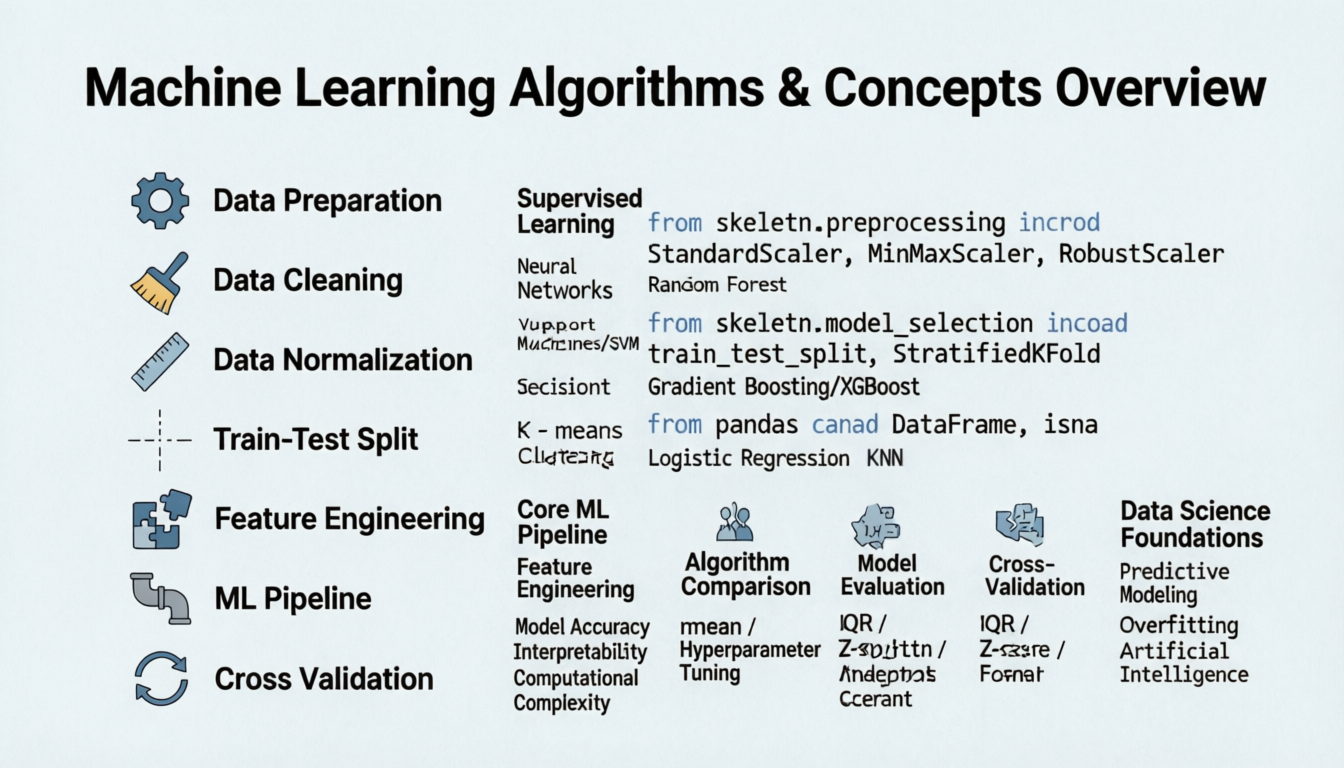
Step 4: Model Selection
Choosing the Right Algorithm for Your Machine Learning Problem
Introduction to Model Selection
Model selection is a critical step in the machine learning pipeline where you choose the appropriate algorithm based on your problem type, data characteristics, computational resources, and performance requirements. The right model can mean the difference between success and failure in your project.
Understanding Problem Types
Before selecting a model, you must clearly understand your problem type:
| Problem Type | Description | Example Algorithms |
|---|---|---|
| Supervised Learning – Classification | Predicting categorical labels | Logistic Regression, Decision Trees, Random Forest, SVM, Neural Networks |
| Supervised Learning – Regression | Predicting continuous values | Linear Regression, Decision Trees, Random Forest, Neural Networks |
| Unsupervised Learning – Clustering | Grouping similar data points | K-Means, DBSCAN, Hierarchical Clustering |
| Unsupervised Learning – Dimensionality Reduction | Reducing feature space | PCA, t-SNE, Autoencoders |
Popular Machine Learning Algorithms
1. Decision Trees
Decision trees create a tree-like model of decisions based on feature values. They split data recursively based on the most informative features.
✓ Advantages
- Easy to understand and interpret
- Requires little data preprocessing
- Handles both numerical and categorical data
- Can capture non-linear relationships
✗ Disadvantages
- Prone to overfitting
- Can be unstable with small data changes
- Biased with imbalanced datasets
- May create overly complex trees
2. Random Forest
Random Forest is an ensemble method that builds multiple decision trees and merges their predictions. It reduces overfitting by averaging results from many trees trained on different data subsets.
✓ Advantages
- Highly accurate and robust
- Reduces overfitting compared to single trees
- Handles missing values well
- Provides feature importance rankings
✗ Disadvantages
- Less interpretable than single trees
- Computationally expensive
- Requires more memory
- Slower prediction time
3. Support Vector Machines (SVM)
SVMs find the optimal hyperplane that maximally separates different classes in high-dimensional space. They use kernel functions to handle non-linear relationships.
✓ Advantages
- Effective in high-dimensional spaces
- Works well with clear margin of separation
- Memory efficient (uses subset of training points)
- Versatile with different kernel functions
✗ Disadvantages
- Not suitable for large datasets
- Doesn’t perform well with noisy data
- Requires feature scaling
- Difficult to interpret
4. Neural Networks
Neural networks are composed of interconnected layers of nodes (neurons) that learn complex patterns through backpropagation. Deep neural networks have multiple hidden layers.
✓ Advantages
- Can model extremely complex patterns
- Excellent for unstructured data (images, text, audio)
- Scales well with large datasets
- State-of-the-art performance on many tasks
✗ Disadvantages
- Requires large amounts of data
- Computationally expensive to train
- Black box – difficult to interpret
- Prone to overfitting without proper regularization
5. Gradient Boosting (XGBoost, LightGBM, CatBoost)
Gradient boosting builds models sequentially, where each new model corrects errors made by previous models. Modern implementations like XGBoost are highly optimized and widely used in competitions.
✓ Advantages
- Often provides best performance on structured data
- Handles missing values automatically
- Built-in feature importance
- Robust to outliers
✗ Disadvantages
- Prone to overfitting if not tuned properly
- Requires careful hyperparameter tuning
- Can be slow to train
- Less interpretable
6. K-Nearest Neighbors (KNN)
KNN is a non-parametric method that classifies data points based on the majority class of their k nearest neighbors in the feature space.
✓ Advantages
- Simple to understand and implement
- No training phase (lazy learning)
- Naturally handles multi-class problems
- Adapts as new training data is added
✗ Disadvantages
- Slow prediction time with large datasets
- Requires feature scaling
- Sensitive to irrelevant features
- Doesn’t work well in high dimensions
7. Logistic Regression
Despite its name, logistic regression is a classification algorithm that models the probability of binary outcomes using a logistic function.
✓ Advantages
- Simple, fast, and efficient
- Outputs probability scores
- Works well with linearly separable data
- Easy to interpret and explain
✗ Disadvantages
- Assumes linear decision boundary
- Limited to linear relationships
- Requires feature engineering for complex patterns
- Sensitive to outliers
8. K-Means Clustering
K-Means partitions data into k clusters by iteratively assigning points to the nearest cluster center and updating centers based on cluster members.
✓ Advantages
- Simple and fast
- Scales well to large datasets
- Works well with spherical clusters
- Easy to implement
✗ Disadvantages
- Requires specifying number of clusters (k)
- Sensitive to initial centroid placement
- Struggles with non-spherical clusters
- Sensitive to outliers
Model Selection Decision Framework
Key Factors to Consider:
1. Dataset Size
- Small datasets (< 1,000 samples): Logistic/Linear Regression, Decision Trees, KNN
- Medium datasets (1,000 – 100,000): Random Forest, SVM, Gradient Boosting
- Large datasets (> 100,000): Neural Networks, Gradient Boosting, Deep Learning
2. Problem Complexity
- Linear relationships: Linear/Logistic Regression
- Non-linear relationships: Decision Trees, Random Forest, Neural Networks
- Highly complex patterns: Deep Neural Networks, Gradient Boosting
3. Interpretability Requirements
- High interpretability needed: Linear/Logistic Regression, Decision Trees
- Moderate interpretability: Random Forest (feature importance)
- Low interpretability acceptable: Neural Networks, SVM with complex kernels
4. Training Time Constraints
- Fast training needed: Linear/Logistic Regression, Naive Bayes, KNN
- Moderate training time: Decision Trees, Random Forest
- Longer training acceptable: Neural Networks, SVM, Gradient Boosting
5. Feature Characteristics
- Numerical features: Most algorithms work well
- Categorical features: Decision Trees, Random Forest, CatBoost
- Text data: Neural Networks, SVM, Naive Bayes
- Image data: Convolutional Neural Networks (CNNs)
- Sequential data: Recurrent Neural Networks (RNNs), LSTMs
Practical Implementation Example
Here’s a Python example demonstrating how to compare multiple models:
from sklearn.model_selection import cross_val_score
from sklearn.tree import DecisionTreeClassifier
from sklearn.ensemble import RandomForestClassifier, GradientBoostingClassifier
from sklearn.svm import SVC
from sklearn.linear_model import LogisticRegression
from sklearn.neighbors import KNeighborsClassifier
import numpy as np

# Define models to compare
models = {
    'Logistic Regression': LogisticRegression(random_state=42),
    'Decision Tree': DecisionTreeClassifier(random_state=42),
    'Random Forest': RandomForestClassifier(random_state=42),
    'SVM': SVC(random_state=42),
    'KNN': KNeighborsClassifier(),
    'Gradient Boosting': GradientBoostingClassifier(random_state=42)
}

# Compare models using cross-validation
results = {}
for name, model in models.items():
    cv_scores = cross_val_score(model, X_train, y_train, cv=5, scoring='accuracy')
    results[name] = {
        'mean_score': cv_scores.mean(),
        'std_score': cv_scores.std()
    }
    print(f"{name}: {cv_scores.mean():.4f} (+/- {cv_scores.std():.4f})")

# Select best model
best_model_name = max(results, key=lambda x: results[x]['mean_score'])
print(f"\nBest Model: {best_model_name}")

# Train best model on full training set
best_model = models[best_model_name]
best_model.fit(X_train, y_train)
Algorithm Selection Cheat Sheet
| Scenario | Recommended Algorithms |
|---|---|
| Structured/tabular data, high accuracy needed | Gradient Boosting (XGBoost, LightGBM), Random Forest |
| Image classification/recognition | Convolutional Neural Networks (CNNs) |
| Text classification/NLP tasks | Transformers (BERT, GPT), LSTM, SVM |
| Time series forecasting | LSTM, ARIMA, Prophet, Gradient Boosting |
| Recommendation systems | Collaborative Filtering, Neural Networks, Matrix Factorization |
| Anomaly detection | Isolation Forest, One-Class SVM, Autoencoders |
| Customer segmentation | K-Means, Hierarchical Clustering, DBSCAN |
| Interpretable predictions needed | Logistic Regression, Decision Trees, Linear Regression |
Best Practices for Model Selection
Common Pitfalls to Avoid
- Choosing complex models for small datasets: Deep learning requires large amounts of data. Use simpler models for small datasets.
- Ignoring computational constraints: Some models require significant computational resources. Consider your infrastructure limitations.
- Overlooking interpretability: In regulated industries (healthcare, finance), model interpretability may be legally required.
- Not considering deployment: A model that’s too large or slow may not be practical for production deployment.
- Blindly following benchmarks: What works for one dataset may not work for yours. Always validate on your specific data.
Conclusion
Model selection is both an art and a science. While guidelines and best practices can point you in the right direction, the best model for your specific problem can only be determined through experimentation and validation. Start with a clear understanding of your problem, data characteristics, and constraints, then systematically evaluate multiple algorithms using proper validation techniques.
Remember that model selection is iterative. You may need to revisit this step after feature engineering or when you get new insights from model evaluation. The goal is not to find the perfect model immediately, but to identify promising candidates that can be further refined through hyperparameter tuning and optimization.