



Metacognition
A pattern for systems that monitor, evaluate, and regulate their own reasoning processes in real-time.
What is Metacognition?
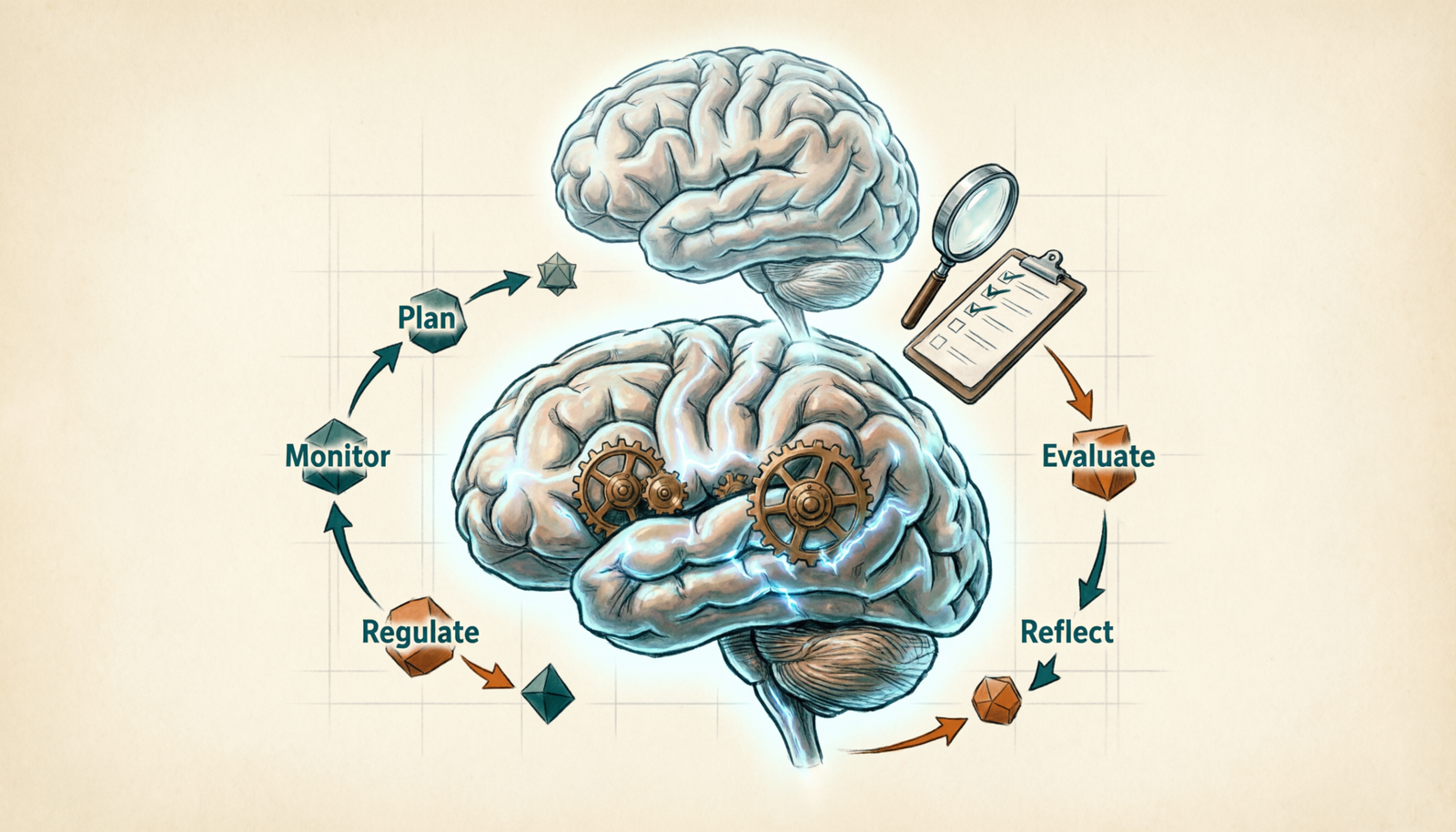
Metacognition is “thinking about thinking” — a design pattern where a system (human, AI, or software) actively observes its own cognitive processes, evaluates their quality, and adjusts its strategies accordingly. It separates the object-level (solving the problem) from the meta-level (managing how to solve it).
Student Reading Comprehension
A student applies metacognition while studying a complex textbook chapter.
- Plan “This chapter is dense. I’ll read slowly and stop every page to summarize.”
- Monitor “I’m re-reading this paragraph — I must not understand it.”
- Evaluate “My summary is vague. I don’t actually understand the concept.”
- Regulate “Let me look up the term and try a different approach.”
- Reflect “Visual diagrams helped me more than rereading text.”
LLM Chain-of-Thought Reasoning
A large language model uses metacognitive prompting to improve accuracy.
- Plan “Break this math problem into sub-steps before answering.”
- Monitor “Step 3 result seems inconsistent with Step 2 — recheck.”
- Evaluate “My confidence in this answer is low due to ambiguous phrasing.”
- Regulate “Reframe the question and try again with different assumptions.”
- Reflect “Flag uncertainty in final response output to user.”
Debugging a Complex Bug
A senior engineer applies metacognition during a hard-to-reproduce production bug.
- Plan “Systematically eliminate subsystems rather than guessing randomly.”
- Monitor “I’ve been on this for 2hrs with no progress — my hypothesis is wrong.”
- Evaluate “I’m too invested in my initial theory. I’m experiencing tunnel vision.”
- Regulate “Step back, rubber duck debug, ask a colleague.”
- Reflect “Update debugging checklist; add ‘check env variables’ earlier.”
Elite Athlete Mid-Game Adjustment
A tennis player applies real-time self-regulation during a match.
- Plan “My game plan: serve wide, attack the net.”
- Monitor “I’ve lost three points in a row from that tactic.”
- Evaluate “Opponent has adapted. My strategy is now predictable.”
- Regulate “Switch to baseline play. Change tempo. Introduce slice.”
- Reflect “Note which adjustments worked for post-match training review.”
Clinical Diagnostic Reasoning
A physician navigates a complex, ambiguous patient presentation.
- Plan “Generate top 3 differential diagnoses based on presenting symptoms.”
- Monitor “Lab results don’t fit my primary hypothesis.”
- Evaluate “I may be anchoring on the most common diagnosis.”
- Regulate “Consider rare conditions. Order additional targeted tests.”
- Reflect “Case taught me to weight atypical presentations more.”
Strategic Decision Making
A product manager evaluates a high-stakes product pivot decision.
- Plan “Define success metrics and decision criteria before gathering data.”
- Monitor “I notice I’m only seeking data that confirms the pivot.”
- Evaluate “Confirmation bias detected — I need adversarial review.”
- Regulate “Run pre-mortem. Assign devil’s advocate on the team.”
- Reflect “Decision frameworks prevent emotional over-involvement.”