


Neural Networks 101
A gentle, visual introduction to how machines learn — from a single neuron to deep learning — with examples you already know.
🧠 What is a Neural Network?
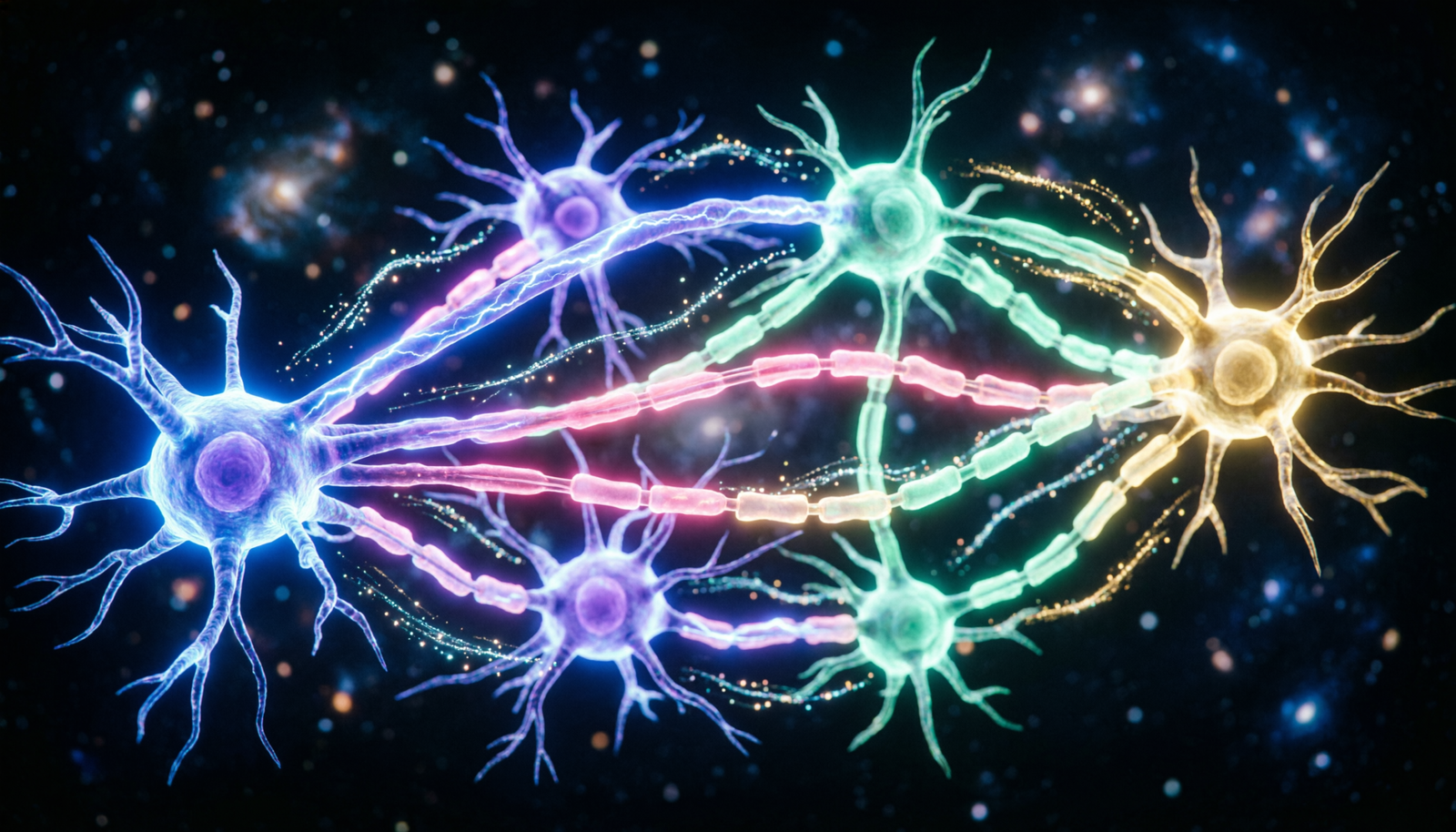
A neural network is a computational system loosely inspired by the human brain. It’s made of thousands of tiny processing units called neurons, connected in layers. Each connection carries a weight — a number that says how important that signal is.
By adjusting these weights during training, the network learns patterns from data — just like a child learning to recognise cats after seeing many pictures.
⚡ A Single Neuron
One neuron takes several inputs, multiplies each by a weight, sums them up, adds a bias, then passes the result through an activation function to decide its output.
🏗️ Network Architecture
Neurons are stacked in layers. Data flows left to right — from the input layer through one or more hidden layers, to the output layer.
Raw data features
Feature detection
Abstraction
Prediction
More hidden layers = Deep Learning. Depth lets the network learn increasingly complex representations — edges → shapes → faces, for example.
🔄 How a Neural Network Learns
Training is a loop: make a prediction, measure the error, adjust the weights. Repeat millions of times.
⚡ Activation Functions
Without activation functions, a neural network is just a linear equation — no matter how deep. Activations introduce non-linearity, allowing the network to model complex patterns.
ReLU
max(0, x) — The workhorse. Outputs 0 for negatives, x otherwise. Fast and effective for hidden layers.
Sigmoid
Squashes output to (0,1). Perfect for binary classification outputs — represents probability.
Tanh
Squashes to (-1,1). Zero-centred, which can make training faster than sigmoid.
Softmax
Converts raw scores to probabilities across multiple classes. Used in the output layer for multi-class tasks.
🌍 Real-World Examples
Neural networks power many everyday experiences. Here are a few you’ve definitely encountered:
Image Recognition
Your phone’s face unlock and Instagram filters — Convolutional Neural Networks (CNNs) detect shapes, textures, and faces.
Voice Assistants
Siri, Alexa, and Google Assistant convert sound waves to words using Recurrent Neural Networks (RNNs).
Language Translation
Google Translate uses Transformer networks — massive NNs trained on billions of sentence pairs across languages.
Recommendations
Netflix, YouTube, and Spotify use NNs to learn your tastes and surface content you’ll love.
Self-Driving Cars
Camera feeds, LiDAR, and sensor data are processed by deep NNs in real-time to steer and detect obstacles.
ChatBots (like me!)
Large Language Models are Transformer-based NNs trained on vast text corpora to generate coherent language.
🚀 Getting Started
Ready to build your own? Here’s a beginner roadmap:
- Learn Python basics — the lingua franca of ML. NumPy and Pandas are your first friends.
- Understand Linear Algebra & Calculus — vectors, matrices, gradients. Khan Academy covers everything you need for free.
- Study Andrew Ng’s Machine Learning course — the gold standard introduction on Coursera.
- Use PyTorch or TensorFlow — powerful libraries that handle the heavy maths for you so you focus on architecture.
- Build a small project — try classifying handwritten digits with MNIST. It’s the “Hello World” of neural nets.
- Experiment and iterate — tweak layers, learning rates, and activation functions. Intuition grows through practice.
📖 Key Terms Cheat Sheet
One full pass through the entire training dataset.
How many samples are processed before updating weights.
How big each weight update step is. Too large = unstable; too small = slow.
When the model memorises training data but fails on new data.
Randomly switching off neurons during training to prevent overfitting.
All the weights and biases in the network. GPT-4 has ~1 trillion!