

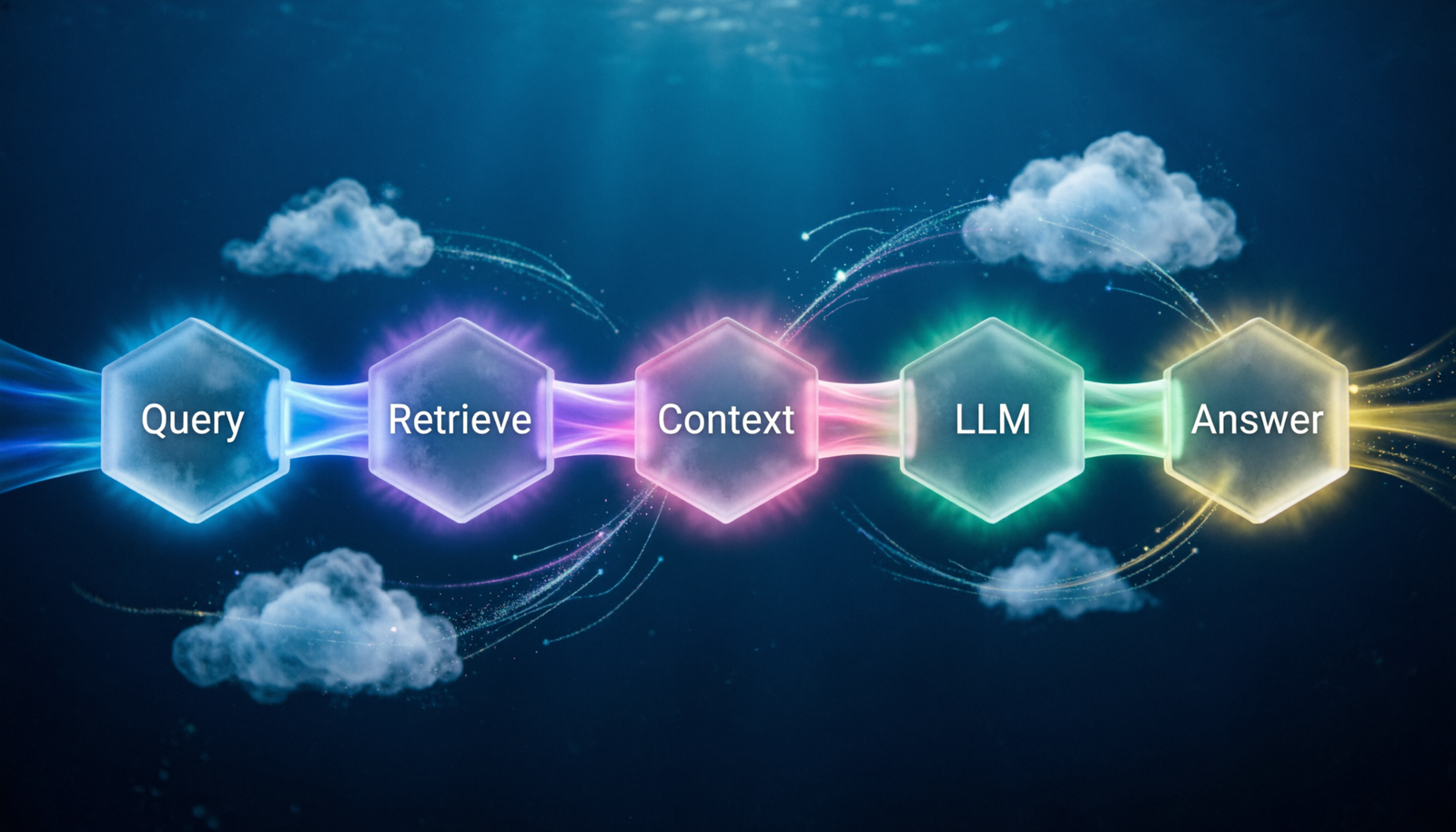

Retrieval-Augmented
Generation
A technique that grounds large language models in real, up-to-date knowledge — by fetching relevant documents before generating a response.
Vector Store
Documents are chunked and embedded into high-dimensional vectors. A similarity search finds the chunks most semantically relevant to the user’s query.
Embedding Model
Converts text into dense numerical representations. Similar meanings cluster nearby in vector space — enabling fuzzy, semantic matching beyond keywords.
Augmented Prompt
Retrieved chunks are injected into the prompt as grounding context. The LLM synthesizes this external knowledge with its parametric training.
Chunking Strategy
How you split documents matters enormously. Fixed-size, sentence-aware, and recursive character splitting each suit different document types.
Top-K Retrieval
Only the K most relevant chunks (typically 3–10) are passed to the model, balancing context richness against the LLM’s context window size.
Hallucination Guard
Because the model must stay grounded in retrieved text, RAG dramatically reduces confident but fabricated answers — a key reliability benefit.
RAG vs Fine-Tuning vs Prompting
| Dimension | Prompting Only | Fine-Tuning | RAG |
|---|---|---|---|
| Knowledge freshness | Static | Re-train needed | Live / updatable |
| Setup cost | Near zero | High (GPU time) | Moderate |
| Factual grounding | Low | Medium | High |
| Citable sources | No | No | Yes |
| Custom style/tone | Partial | Strong | Partial |
| Scales to large corpus | No | Tricky | Yes |
Minimal Python Example
# Minimal RAG pipeline with LangChain + FAISS
from langchain.embeddings import OpenAIEmbeddings
from langchain.vectorstores import FAISS
from langchain.chat_models import ChatOpenAI
from langchain.chains import RetrievalQA

# 1. Embed & index your documents
embeddings = OpenAIEmbeddings()
vectorstore = FAISS.from_documents(docs, embeddings)

# 2. Build retriever (top-4 chunks)
retriever = vectorstore.as_retriever(
    search_kwargs={"k": 4}
)

# 3. Attach LLM and run
qa_chain = RetrievalQA.from_chain_type(
    llm=ChatOpenAI(model="gpt-4o"),
    retriever=retriever,
    return_source_documents=True,
)

result = qa_chain.invoke({"query": "What is our refund policy?"})
print(result["result"])
# → Grounded answer with source citations ✨
Common Use Cases
Enterprise Q&AAsk questions over internal wikis, policies, or Confluence pages.
Legal ResearchSurface relevant case law and statute excerpts instantly.
Customer SupportGround chatbots in live product docs and FAQs.
Medical LiteratureQuery PubMed abstracts with source citations.
Code SearchRetrieve relevant functions before generating code.
News SummarizationCondense recent articles beyond the model’s cutoff.