

Hierarchical vs.
Peer-to-Peer
Agent Interaction Patterns
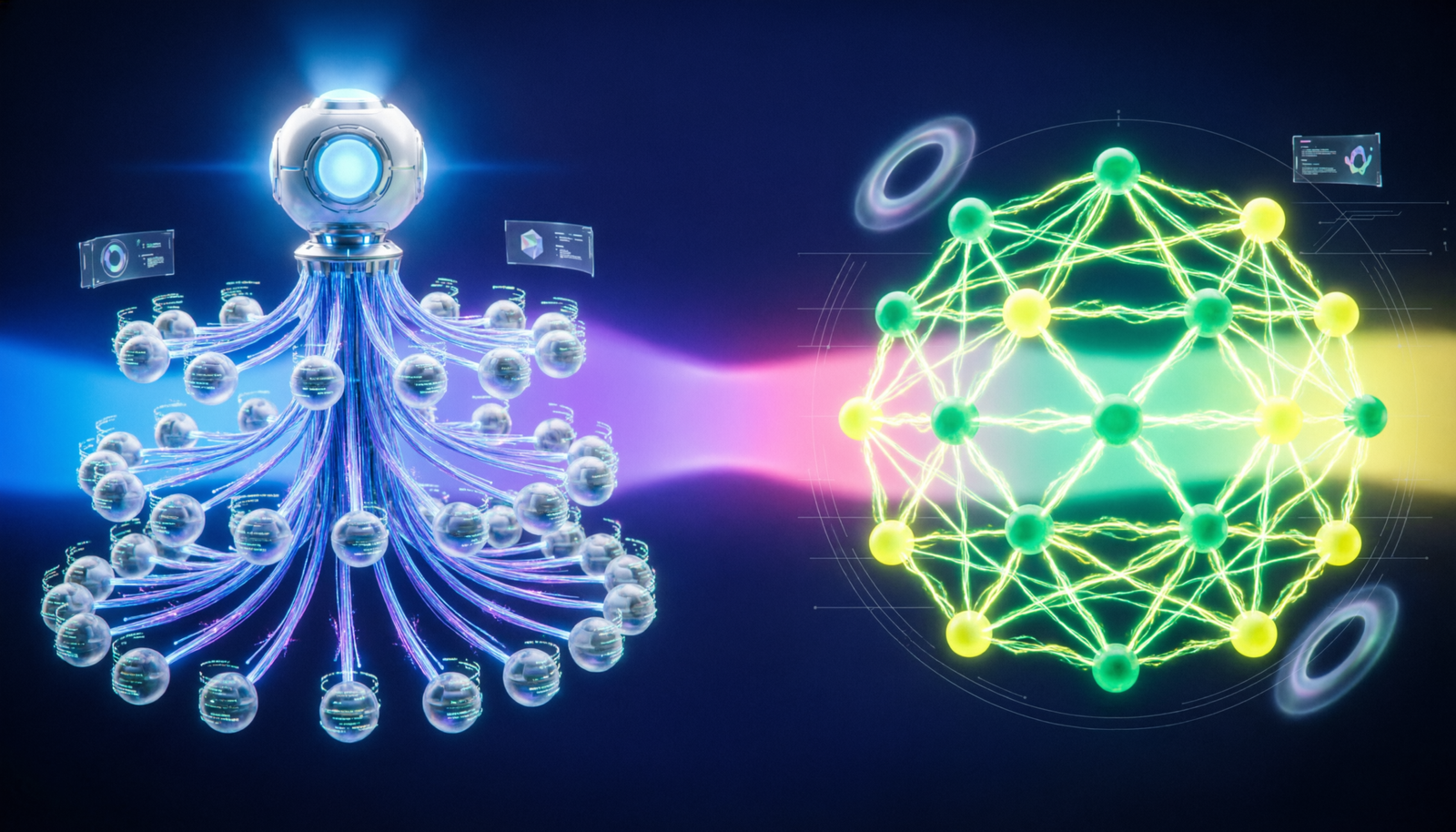
Two fundamental architectures govern how AI agents coordinate. Each embodies a distinct philosophy of control, trust, and information flow — choosing the right pattern shapes everything from latency to resilience.
Command & Control
A central orchestrator directs subordinate agents, delegating tasks, aggregating results, and maintaining authoritative state. Information and decisions flow along a strict tree.
- Orchestrator holds the global plan
- Sub-agents receive bounded instructions
- Results bubble up for synthesis
- Clear accountability chain
- Single source of truth for state
- Easier to audit and debug
Collective Intelligence
Agents negotiate directly with one another as equals. Coordination emerges from local interactions, shared protocols, and consensus — no single node holds authority.
- All agents have equivalent standing
- Decentralized decision-making
- Emergent coordination via protocols
- Resilient — no single point of failure
- Highly parallel execution
- Scales horizontally with ease
🏛️ Hierarchical
🕸️ Peer-to-Peer
| Dimension | Hierarchical | Peer-to-Peer |
|---|---|---|
| Control | Centralized — orchestrator owns global state and task delegation | Distributed — authority negotiated among peers via protocol |
| Fault Tolerance | Single point of failure at the orchestrator level | Highly resilient — loss of any one node rarely disrupts the whole |
| Scalability | Vertical — deeper trees add latency at each hop | Horizontal — add peers without redesigning the graph |
| Explainability | Easy — follow the delegation chain upward | Hard — emergent behavior is difficult to trace |
| Coordination Cost | Low per-agent; all overhead sits at the orchestrator | High aggregate cost of consensus and message passing |
| Latency | Higher for deep trees; bottleneck at root | Lower for parallel workloads; no central bottleneck |
| Trust Model | Inherited from parent; orchestrator is fully trusted | Each peer must independently validate messages |
| Ideal Task Size | Complex, sequential, interdependent tasks | Embarrassingly parallel, loosely coupled tasks |
Autonomous Research
A planner agent decomposes a research brief, dispatching specialist sub-agents for literature, data, and synthesis.
HierarchicalManufacturing Swarms
Robotic agents on a factory floor negotiate resource allocation and task handoffs with no central controller.
Peer-to-PeerLegal Review Pipeline
A head agent assigns contract clauses to reviewers, collects flags, and composes a unified risk report.
HierarchicalDistributed Web Crawling
Crawler peers discover and claim URLs independently, sharing a distributed index without a master coordinator.
Peer-to-PeerCustomer Service Triage
A routing orchestrator classifies tickets and dispatches to domain specialists — billing, tech, refunds.
HierarchicalFederated Learning Nodes
Model-training agents share gradients peer-to-peer, aggregating learning without exposing raw data centrally.
Peer-to-PeerFollow Dependency Structure
Tasks with strong inter-dependencies map naturally to hierarchical patterns. Independent, embarrassingly-parallel work belongs in peer networks.
Trust Determines Topology
Hierarchical patterns assume inherited trust downward. P2P requires each agent to independently verify every message — design your trust model first.
Observability Requires Architecture
Hierarchical systems are easier to trace. P2P demands investment in distributed tracing, correlation IDs, and gossip logs to achieve comparable visibility.
Failure Modes Differ Radically
Hierarchical systems fail catastrophically when the root fails; P2P degrades gracefully. Match your fault tolerance budget to your architecture choice.