Bestseller #1
Bestseller #2

Bestseller #3

Bestseller #4

Bestseller #5
Bestseller #6

Multi-Agent Systems
Designing Agent Roles
Supervisors, Workers & Evaluators
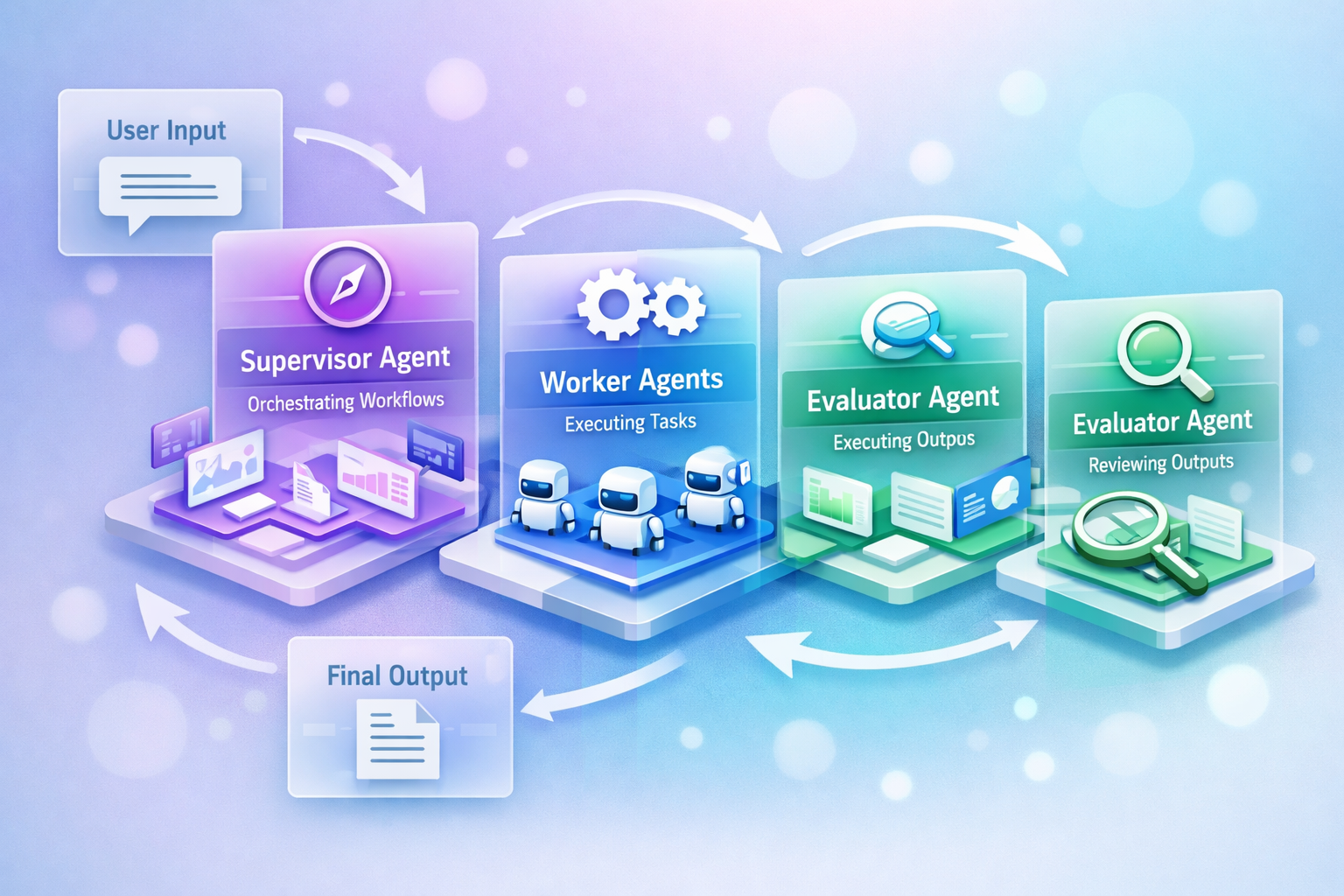
Effective multi-agent systems emerge when each agent has a clear mandate, bounded authority, and well-defined interfaces with its peers.
Role 01
Supervisor
Orchestrates the overall pipeline — breaks goals into tasks, routes work to specialists, resolves conflicts, and synthesizes final outputs.
- Maintains high-level context and goal state
- Delegates sub-tasks with clear instructions
- Handles ambiguity, re-planning, escalation
- Owns the final output contract
- Has limited direct tool access
Role 02
Worker
Executes concrete, scoped tasks — calls APIs, runs code, searches databases, transforms data — and returns structured results.
- Narrow scope, deep tool expertise
- Stateless between tasks (clean slate)
- Returns typed, verifiable outputs
- Reports failures precisely, not silently
- Specialised per domain or capability
Role 03
Evaluator
Independently checks outputs against quality criteria — catching errors, policy violations, and misalignments before they propagate downstream.
- Structurally independent from producers
- Applies explicit rubrics or learned norms
- Returns scores, flags, and rationales
- Can trigger revision loops or escalation
- May itself be validated by meta-evaluators
Typical information flow
👤
User / Task
→
🧭
Supervisor
→
⚙️
Worker(s)
→
🔍
Evaluator
→
🧭
Supervisor
→
✅
Final output
Role interactions
Who communicates with whom, and how
| From → To | Channel type | Payload | Trigger |
|---|---|---|---|
| Supervisor → Worker | Task dispatch | Instructions, context window, tool spec | Goal decomposition |
| Worker → Supervisor | Result return | Structured output, error, confidence | Task completion or failure |
| Supervisor → Evaluator | Review request | Output + rubric + expected criteria | Pre-delivery quality gate |
| Evaluator → Supervisor | Verdict | Pass / Revise / Reject + rationale | Post-evaluation |
| Evaluator → Worker | Correction hint | Targeted error feedback | Revision loop (supervisor-mediated) |
01
Separation of concerns
Each role has one primary responsibility. Mixing orchestration with execution degrades reliability.
02
Minimal authority
Grant agents the narrowest tool access needed. Broad permissions create unpredictable cascades.
03
Independent evaluation
Evaluators must be structurally separate from producers to avoid sycophantic validation.
04
Typed interfaces
Define schema contracts between roles. Free-text hand-offs compound errors across agents.
05
Graceful escalation
Every role should have a clear escalation path when confidence drops below threshold.
Bestseller #1
Bestseller #2

Bestseller #4