

Implementing Vector-Based
Memory for Supply Chains
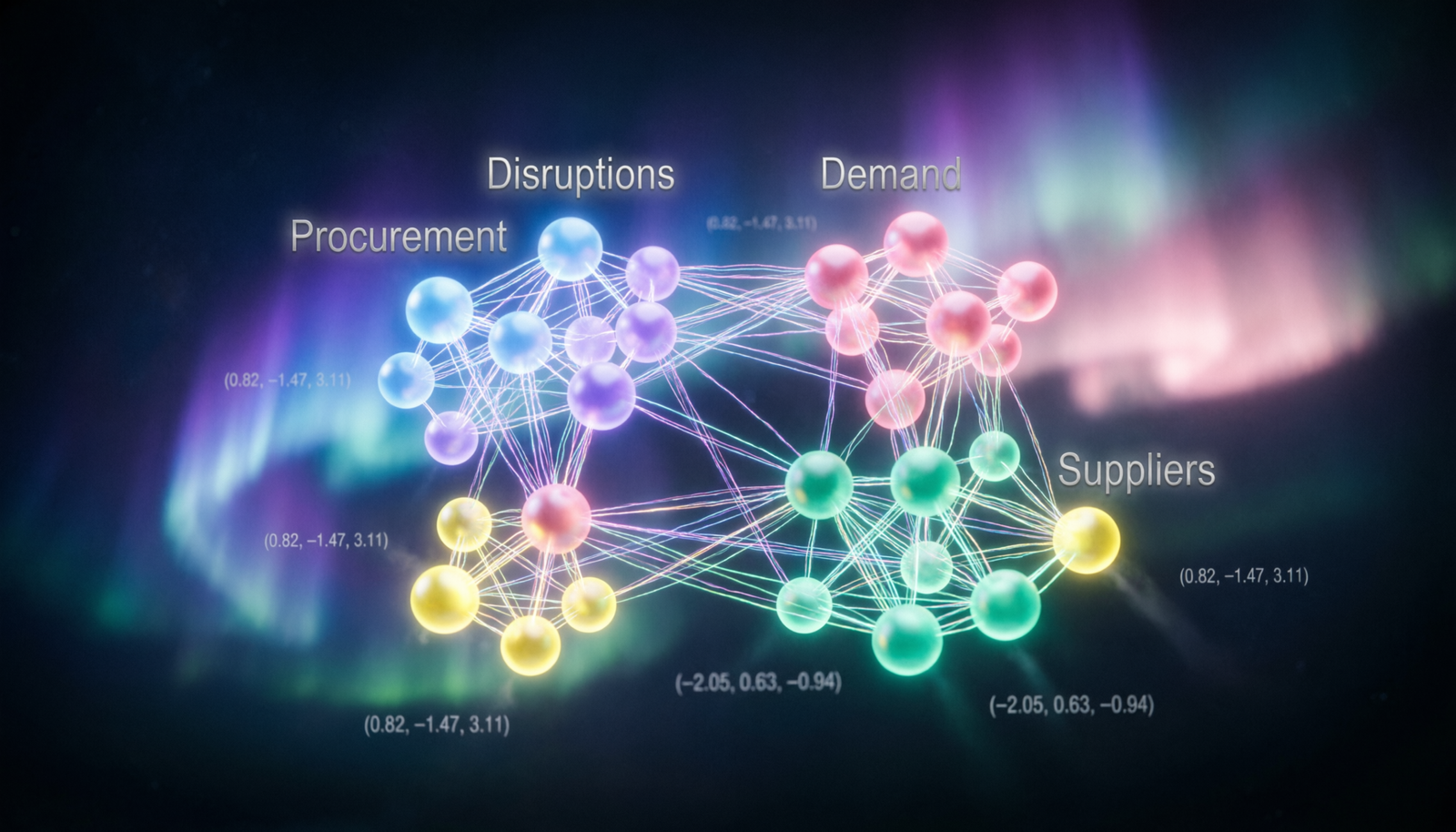
How semantic embeddings transform raw operational data into a persistent, queryable memory layer — enabling AI agents to reason across procurement cycles, disruptions, and demand patterns.
Procurement History
Embeddings of purchase orders, vendor negotiations, lead times, and contract terms indexed by semantic similarity to enable analogical reasoning across procurement decisions.
Disruption Events
Past supply shocks, port delays, weather impacts, and geopolitical events stored as dense vectors so agents can retrieve precedents matching current disruption signatures.
Demand Signals
Historical demand patterns, seasonal spikes, promotional responses, and forecast deviations encoded to surface relevant past behaviors during prediction tasks.
Supplier Profiles
Capability matrices, quality scores, capacity constraints, and relationship context embedded to power intelligent supplier selection and risk scoring.
| Memory Event | Namespace | Similarity Score |
|---|---|---|
|
Port congestion led to 18-day delay for APAC components (Q3 2022) logisticsdelayapac |
disruptions | |
|
Safety stock increase by 30% mitigated semiconductor shortage impact inventorysemiconductor |
procurement | |
|
Supplier B dual-sourced at 60/40 split reduced cost by 12% dual-sourcecost |
suppliers | |
|
Demand spike of 240% during holiday season, 3 weeks prior signal demandseasonal |
demand | |
|
Vendor quality audit flagged 4.2% defect rate — contingency activated qualityrisk |
suppliers |
import { SupplyChainMemory } from '@scm/vector-memory';

// Initialize memory store with namespace partitions
const memory = await SupplyChainMemory.init({
  model: 'text-embedding-3-large',
  dims:  1536,
  store: 'pinecone',
  namespaces: ['procurement', 'disruptions', 'demand', 'suppliers'],
});

// Store a supply event into vector memory
await memory.remember({
  namespace: 'disruptions',
  text: 'Port congestion caused 18-day delay for APAC components',
  metadata: { region: 'APAC', impact: 'high', resolved: true },
});

// Semantic retrieval — find similar past disruptions
const similar = await memory.recall({
  namespace: 'disruptions',
  query: 'shipping lane blockage causing component delays',
  topK: 5,
  minScore: 0.75,
});

// Augment agent prompt with retrieved memories
const context = similar.map(m => m.text).join('\n---\n');
const response = await agent.reason({ context, query });