

Introduction to
Artificial Intelligence
& Generative AI
A clear, concise overview of what AI is, how it works, key categories, and how Generative AI is transforming the way we create — with real-world examples and a visual flow.
01 What is Artificial Intelligence?
Artificial Intelligence (AI) refers to the simulation of human-like intelligence in machines. AI systems are trained to perceive, reason, learn, and make decisions — tasks that traditionally required human intelligence.
AI is not a single technology but an umbrella term for many techniques: from simple rule-based systems to complex neural networks that learn from vast amounts of data.
Machine Learning
Algorithms that learn patterns from data without being explicitly programmed for every scenario.
Core AIDeep Learning
Multi-layered neural networks inspired by the human brain, powering image recognition and NLP.
Core AINatural Language Processing
Enables computers to read, understand, and generate human language. Powers chatbots & search.
Core AI02 What is Generative AI?
Generative AI is a subset of AI focused on creating new content — text, images, audio, video, code, and more. Rather than just classifying or predicting, Gen AI models generate novel outputs that didn’t exist before.
These models are trained on massive datasets and learn the underlying patterns and structure of that data, then use those patterns to produce brand-new examples on demand.
Text Generation
Write essays, summaries, emails, code, and stories.
GPT-4, Claude, GeminiGen AI
Image Generation
Create photorealistic images or artwork from text prompts.
DALL·E, Midjourney, Stable DiffusionGen AI
Audio & Music
Compose original music, clone voices, or generate sound effects.
Suno, ElevenLabs, MusicLMGen AI
Video Generation
Generate short video clips from a text description.
Sora, Runway, PikaGen AI
Code Generation
Auto-complete, refactor, or write entire programs in any language.
GitHub Copilot, Claude, CursorGen AI
Scientific Content
Generate protein structures, drug molecules, or synthetic data.
AlphaFold, AlphaCodeGen AI
03 Real-World Examples
AI and Generative AI are being applied across every industry. Here are some concrete examples of how they’re used today:
| Industry | Traditional AI Use | Generative AI Use |
|---|---|---|
| 🏥 Healthcare | Diagnosing diseases from X-rays via image classification | Generating synthetic medical data, drafting patient reports |
| 🏦 Finance | Fraud detection, credit scoring | Auto-generating financial summaries & personalized advice |
| 🎓 Education | Adaptive learning pace recommendations | Generating quizzes, tutoring chatbots, personalized lessons |
| 🛍️ Retail | Product recommendation engines | AI-generated product descriptions, ad creatives, try-on images |
| 🎮 Gaming | NPC behavior, matchmaking algorithms | Procedurally generated worlds, storylines, dialogue |
| 📰 Media | Spam detection, content moderation | AI-written articles, personalized news digests, video summaries |
04 How Generative AI Works — Flowchart
Here’s a simplified flow of how a Generative AI model processes a user’s request and produces an output:
(tokenize, embed, format)
(LLM / Diffusion / GAN)
Type?
generates tokens
renders pixels
synthesizes sound
writes & explains
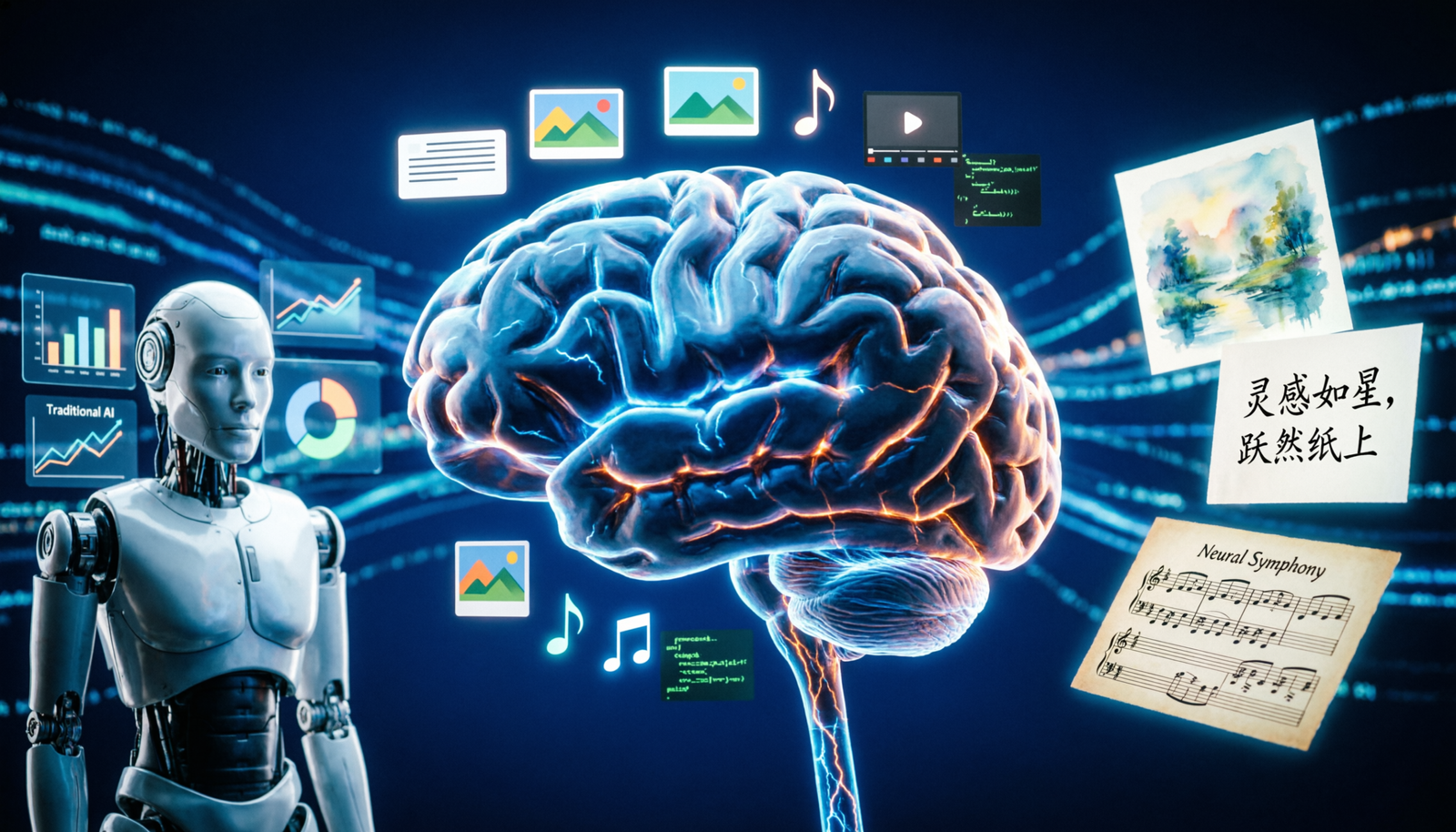
05 Traditional AI vs Generative AI
Traditional AI
Analyzes and classifies existing data. Outputs a label, prediction, or score. Example: “Is this email spam?”
DiscriminativeGenerative AI
Creates new data that resembles training examples. Outputs text, images, or audio from scratch. Example: “Write a poem about the sea.”
Generative