
Bestseller #1
Bestseller #2
🤖 Machine Learning Algorithms Sheet
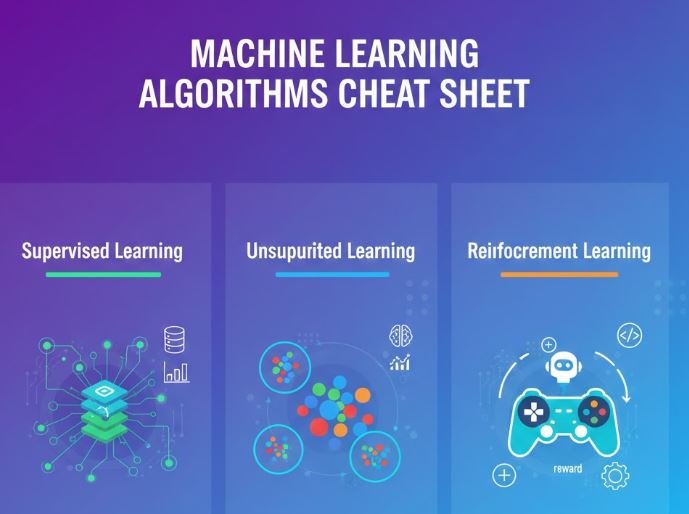
A comprehensive visual breakdown of ML algorithm categories
📊
Supervised Learning
Learning from labeled training data to predict outcomes for unseen data. The algorithm learns the mapping between input features and known output labels.
Regression Algorithms
- Linear Regression Predicts continuous values using linear relationships
- Polynomial Regression Models non-linear relationships with polynomial features
- Ridge & Lasso Regression Regularized linear models to prevent overfitting
- Support Vector Regression (SVR) Uses SVM principles for regression tasks
- Decision Tree Regression Tree-based model for non-linear regression
- Random Forest Regression Ensemble of decision trees for robust predictions
Classification Algorithms
- Logistic Regression Binary and multi-class classification
- K-Nearest Neighbors (KNN) Instance-based learning using proximity
- Support Vector Machine (SVM) Finds optimal hyperplane for classification
- Naive Bayes Probabilistic classifier based on Bayes theorem
- Decision Trees Tree structure for decision making
- Random Forest Ensemble of decision trees for classification
- Gradient Boosting (XGBoost, LightGBM) Sequential ensemble method
- Neural Networks Deep learning models with multiple layers
🔍
Unsupervised Learning
Learning patterns and structures from unlabeled data without predefined outputs. The algorithm discovers hidden patterns on its own.
Clustering Algorithms
- K-Means Clustering Partitions data into K distinct clusters
- Hierarchical Clustering Creates tree of clusters (dendrogram)
- DBSCAN Density-based clustering for arbitrary shapes
- Mean Shift Non-parametric clustering technique
- Gaussian Mixture Models (GMM) Probabilistic clustering model
Dimensionality Reduction
- Principal Component Analysis (PCA) Linear dimensionality reduction technique
- t-SNE Non-linear technique for visualization
- Linear Discriminant Analysis (LDA) Supervised dimensionality reduction
- Autoencoders Neural networks for feature learning
Association Rule Learning
- Apriori Algorithm Finds frequent itemsets in databases
- FP-Growth Efficient pattern mining algorithm
- Eclat Vertical data format for mining
🎮
Reinforcement Learning
Learning through interaction with an environment to maximize cumulative reward. The agent learns optimal actions through trial and error.
Value-Based Methods
- Q-Learning Off-policy TD control algorithm
- SARSA On-policy TD control algorithm
- Deep Q-Network (DQN) Q-learning with deep neural networks
- Double DQN Reduces overestimation in Q-learning
Policy-Based Methods
- Policy Gradient Direct policy optimization
- REINFORCE Monte Carlo policy gradient method
- Trust Region Policy Optimization (TRPO) Constrained policy optimization
- Proximal Policy Optimization (PPO) Simplified version of TRPO
Actor-Critic Methods
- A3C (Asynchronous Advantage Actor-Critic) Parallel training with multiple agents
- A2C (Advantage Actor-Critic) Synchronous version of A3C
- DDPG (Deep Deterministic Policy Gradient) For continuous action spaces
- TD3 (Twin Delayed DDPG) Improved DDPG with reduced variance
- SAC (Soft Actor-Critic) Maximum entropy RL framework
Model-Based Methods
- Monte Carlo Tree Search (MCTS) Planning algorithm for decision making
- Dyna-Q Combines model-based and model-free learning
- AlphaGo/AlphaZero MCTS combined with deep learning
📚 Key Concepts
Supervised Learning: Labeled data with input-output pairs
Unsupervised Learning: Unlabeled data, finds patterns
Reinforcement Learning: Learns through rewards/penalties
Bestseller #1
Bestseller #2
Bestseller #3