
AI Agents in Production

AI Agents in Production Architecture · Lifecycle · Real-World Deployment Patterns

Live Systems
Version 2025 · Field Guide
01 What Is an AI Agent in Production?
Core Definition

An AI agent in production is an autonomous software system powered by a large language model (or similar AI) that perceives its environment, reasons about goals, selects and executes actions via tools, and iterates — all in a live, real-world system serving actual users or business processes.

What makes it “production”?

Production agents operate under reliability constraints (uptime, latency, cost), are integrated into real data pipelines (APIs, databases, external services), handle error recovery without human intervention, and are continuously monitored and evaluated against measurable KPIs.

Key Properties

Autonomy — acts without step-by-step human direction.
Tool Use — calls APIs, searches web, writes code.
Memory — maintains context across sessions or steps.

Distinction from Chatbots

Unlike a chatbot that only responds, a production AI agent initiates multi-step workflows, manages state across turns, makes decisions with real-world consequences, and can run asynchronously — even without a human in the loop.

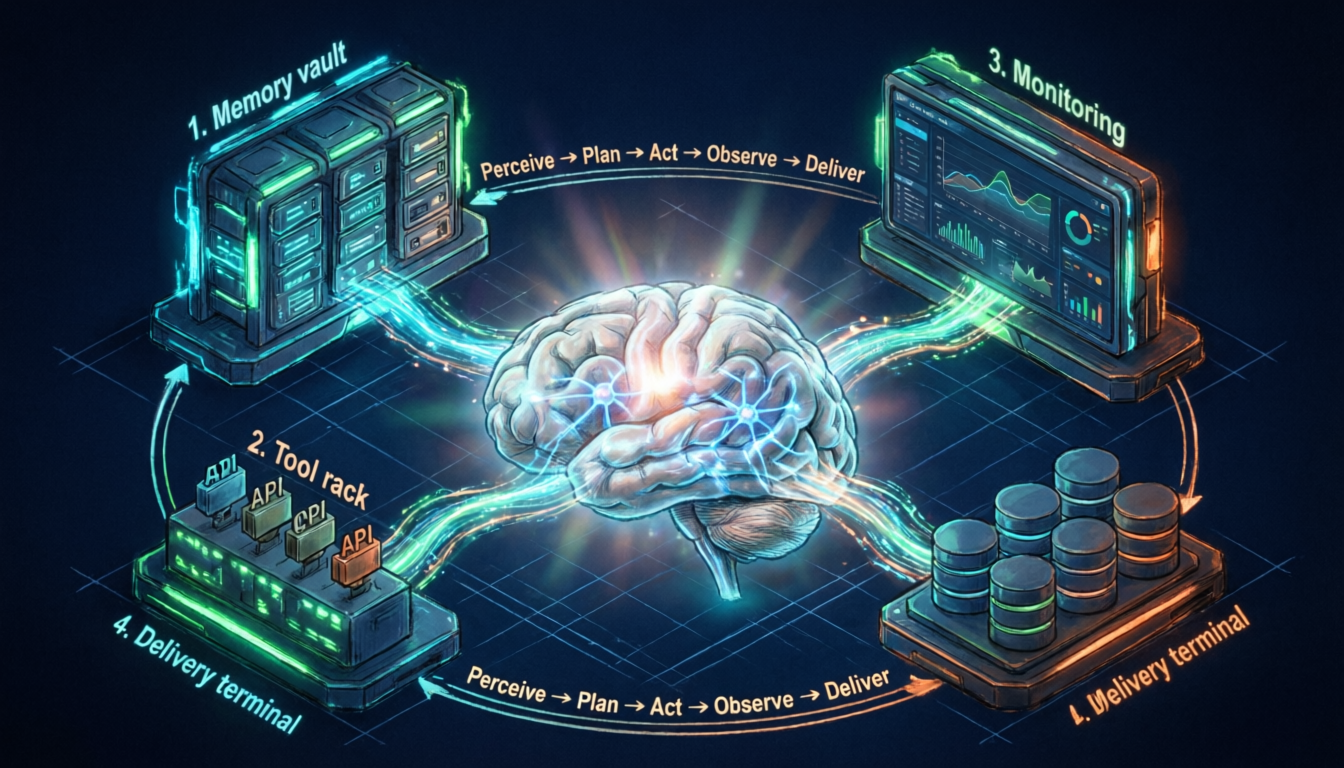
02 Production Agent Lifecycle Flowchart
Input
Trigger
Goal / Task Input
User prompt, API call, scheduled trigger, or event stream activates the agent with a high-level objective.
Context assembly
Memory
Retrieval
Memory & Context Loading
Pull relevant conversation history, user preferences, prior task results, and injected knowledge (RAG / vector search).
reasoning begins
Plan
Orchestration
Task Planning & Decomposition
LLM reasons about the goal. Breaks it into sub-tasks. Selects the strategy (ReAct, Chain-of-Thought, Tree-of-Thought, etc.).
tool call dispatch
Act
Execution
Tool / Action Execution
Agent calls external tools: web search, code interpreter, database queries, API calls, file I/O, sub-agents, or human escalation.
results returned
Observe
Feedback Loop
Observation & Result Parsing
Process tool outputs, error messages, API responses. Update working memory with new observations. Check for unexpected states.
self-evaluation
Eval
Decision Gate
Goal Completion Check
Has the goal been achieved? Is confidence high enough? Has the step limit or cost budget been reached? Should we escalate?
✗ Not Complete

Loop back to Planning. Adjust strategy. Try different tool or approach. Increment iteration counter.

✓ Goal Met

Proceed to output generation. Format results. Persist state. Notify downstream systems or user.

↓ both paths converge at output
Output
Delivery
Response / Action Delivery
Return structured result to user or system. May include text, code, files, API calls, database writes, or triggering downstream agents.
telemetry emit
Monitor
Observability
Logging, Tracing & Evaluation
Emit traces and metrics to monitoring stack (LangSmith, Datadog, etc.). Evaluate output quality. Feed data to continuous improvement pipeline.
03 Common Production Architectures
🔁
ReAct Agent
Alternates between Reasoning and Acting in a tight loop. Each thought triggers an action; each result updates the next thought. Simple and widely deployed.
🌲
Plan-and-Execute
Separates planning (one LLM call generates the full plan) from execution (tools run the steps). Better for long, structured workflows.
🤝
Multi-Agent System
Orchestrator agent delegates to specialized sub-agents (researcher, coder, critic). Enables parallel work and clear role separation at scale.
📚
RAG-Augmented Agent
Retrieves relevant documents from a vector store before reasoning. Grounds the agent in private or up-to-date knowledge bases. Standard for enterprise.
👤
Human-in-the-Loop
Agent pauses at critical decision points for human approval before acting. Required for high-stakes or irreversible actions in regulated environments.
🗃️
Long-Memory Agent
Maintains persistent memory across sessions using external stores. Learns user preferences and accumulates domain knowledge over time.
04 Real-World Production Examples
Customer Support
E-commerce
Autonomous Support Resolution Agent
Handles tier-1 support tickets end-to-end — from intake to resolution — without human involvement for 80%+ of cases.
1
Perceive
Ingest ticket from Zendesk via webhook. Parse customer intent, order ID, sentiment.
2
Retrieve
Query order database, shipping API, and knowledge base for return policies.
3
Act
Execute refund, reroute shipment, or generate personalized reply — autonomously.
4
Escalate
If ambiguous or high-value: route to human agent with full context summary pre-populated.
Software Engineering
DevOps / CI
Autonomous Code Review & Bug Fix Agent
Monitors pull requests, identifies bugs, writes and validates fixes, and submits corrective PRs — continuously.
1
Trigger
GitHub webhook fires on new PR. Agent clones the diff and relevant files.
2
Analyze
Run static analysis tools + LLM reasoning to detect bugs, security issues, code smells.
3
Fix & Test
Generate patch, run tests in sandbox, iterate until all tests pass.
4
Deliver
Open PR with fix, inline review comments, and explanation of changes.
Finance
Research
Market Research & Report Generation Agent
Generates daily investment research reports by autonomously gathering, synthesizing, and formatting market data and news.
1
Schedule
Cron trigger fires at 6AM. Agent spins up with target sectors and report template.
2
Gather
Web search, earnings API, SEC EDGAR, and financial news aggregators queried in parallel.
3
Synthesize
LLM compares sources, identifies trends, flags anomalies, drafts narrative sections.
4
Publish
Report delivered to Slack, email, and internal wiki by 7:30AM with source citations.
Healthcare
Clinical Ops
Prior Authorization Processing Agent
Automates the tedious process of insurance prior auth requests — saving clinics 3-5 hours per day per staff member.
1
Intake
EHR trigger on new prescription. Agent extracts drug, diagnosis codes, patient history.
2
Match
Look up payer-specific PA criteria. Cross-reference patient eligibility and formulary.
3
Draft
Auto-populate PA form, attach supporting clinical documents, write clinical justification note.
4
Review & Submit
Clinician does 30-sec review, approves, agent submits to payer portal electronically.
Sales & Marketing
B2B SaaS
Outbound Lead Research & Outreach Agent
Researches prospect companies, crafts hyper-personalized outreach, and manages follow-up sequences autonomously.
1
Source
Pull new leads from CRM. Enrich with LinkedIn, Crunchbase, and news data via APIs.
2
Research
Scrape company website, recent press releases, job postings. Identify pain points and triggers.
3
Personalize
Generate unique email copy referencing specific company news, role signals, and ICP fit.
4
Sequence
Schedule follow-ups, track opens/replies, adjust messaging based on engagement signals.
Data Engineering
Analytics
Self-Healing Data Pipeline Agent
Monitors ETL pipelines, diagnoses failures, writes corrective SQL/Python, and restores data quality — automatically.
1
Detect
Alert fires from data quality monitor. Agent reads logs, schema, and recent job run history.
2
Diagnose
LLM reasons over stack trace and data sample. Identifies root cause (schema drift, null spike, etc.).
3
Repair
Generate and execute corrective SQL migration or Python patch in staging, validate, promote to prod.
4
Report
Post incident report to Slack with root cause, fix applied, and preventive recommendations.
05 Key Production Challenges
01
Reliability & Hallucination
LLMs can generate confident but incorrect outputs. Production agents need output validation, structured parsing, and fallback chains.
02
Latency & Cost
Multi-step agents with many LLM calls can be slow and expensive. Caching, smaller models for sub-tasks, and parallelism are essential.
03
Observability
Debugging agents requires full trace visibility across every LLM call, tool use, and decision point — not just final outputs.
04
Safety & Guardrails
Agents with real-world action capabilities (email, DB writes, API calls) require strict permission models and action sandboxing.
05
Context Window Limits
Long tasks exceed context windows. Production systems use memory compression, summarization, and retrieval to manage state.
06
Evaluation & Drift
Agent performance degrades as models update or environments change. Continuous eval pipelines and regression testing are non-negotiable.
07
Infinite Loops
Agents can get stuck in reasoning loops. Hard iteration limits, progress detection, and circuit breakers prevent runaway execution.
08
Human Handoff
Graceful escalation to humans — with full context — is critical when confidence is low or stakes are high. This must be a first-class feature.
AI Agents in Production · Field Guide 2025

Leave a Reply

Your email address will not be published. Required fields are marked *