The Art of Inference
& Integration
A practitioner’s compendium on running AI models in production — from token generation mechanics to multi-service orchestration workflows.
From Weights to Words — The Inference Pipeline
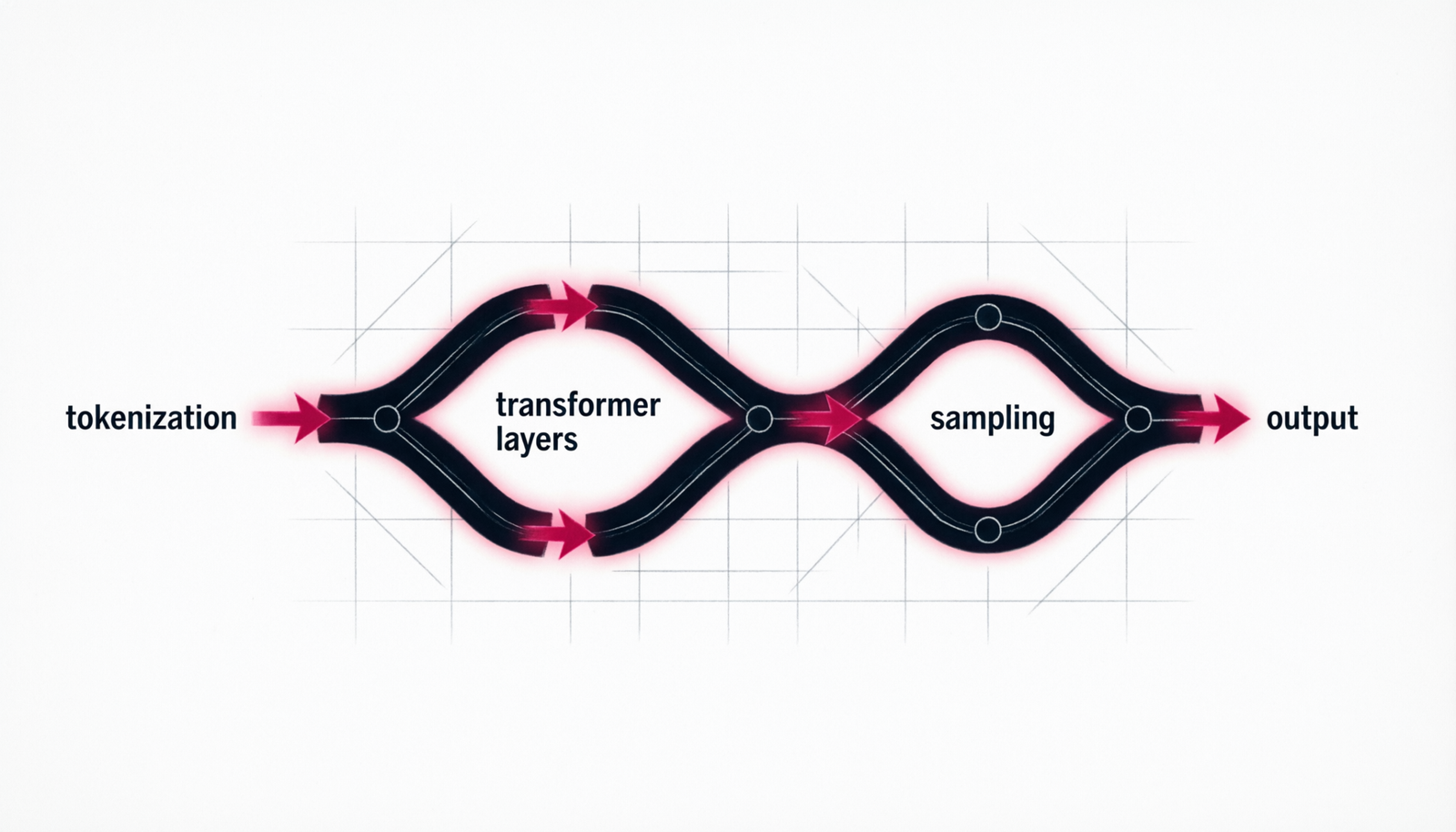
Inference is the act of running a trained neural network forward to produce outputs — predictions, text, images, embeddings. Unlike training (which updates billions of parameters), inference is read-only: the model weights are frozen and you’re simply computing a forward pass.
For large language models, inference means autoregressive token generation: the model predicts the next token, appends it to the context, and repeats until it hits a stop sequence or the maximum token limit.
“Inference is the moment where capability meets reality — where a trained model’s statistical knowledge becomes a concrete, useful output.”Core ML Systems Principle
Every response you receive from an LLM API is the result of hundreds to thousands of individual forward passes through transformer layers — each one attending over the entire context window.
Tuning the Knobs That Shape Output
Every inference call accepts parameters that steer sampling behaviour. Mastering these is the difference between a model that rambles and one that hits the mark.
| Parameter | Range | Effect |
|---|---|---|
| temperature | 0.0 – 2.0 | Randomness of sampling. 0 = deterministic greedy. 1 = model default. >1 = creative chaos. |
| top_p | 0.0 – 1.0 | Nucleus sampling. Only sample from the top-p probability mass. Tightens vocabulary without losing diversity. |
| max_tokens | 1 – context | Hard upper limit on output tokens. Controls cost and latency. |
| stop_sequences | string[] | Generation halts when any of these strings appear. Useful for structured output. |
| stream | bool | If true, returns tokens progressively as SSE events rather than waiting for full completion. |
| system | string | Sets persistent persona, task framing, and constraints for the entire conversation. |
// Minimal Anthropic API call
const response = await fetch(
  "https://api.anthropic.com/v1/messages",
  {
    method: "POST",
    headers: {
      "x-api-key": process.env.ANTHROPIC_API_KEY,
      "anthropic-version": "2023-06-01",
      "content-type": "application/json",
    },
    body: JSON.stringify({
      model: "claude-sonnet-4-20250514",
      max_tokens: 1024,
      temperature: 0.7,
      system: "You are a senior engineer.",
      messages: [
        { role: "user",
          content: "Explain KV caching." }
      ],
    }),
  }
);

const data = await response.json();
console.log(data.content[0].text);
↑ Every call is stateless. The full conversation history must be sent with each request.
Six Patterns Every Builder Must Know
Integrating LLM inference into real products requires well-established architectural patterns. Each solves a distinct class of problem.
Simple Completion
Single-turn prompt → response. Stateless. Best for classification, extraction, summarisation, and one-shot transformations. Zero state management overhead.
Conversational Loop
Maintain a messages array and append each turn. The API has no memory — you own the history. Use sliding-window truncation at context limits.
RAG Pipeline
Retrieval-Augmented Generation: embed the query, fetch semantically similar chunks from a vector store, then inject them as context before calling the model.
Tool Use / Function Calling
Define tools as JSON schemas. The model decides when to call them; you execute them and return results. Enables grounding in live data and real-world actions.
Agentic Loop
Model reasons, selects a tool, receives the result, reasons again — repeatedly. The loop continues until the model emits a final answer. Power with caution.
Batch / Async Processing
Queue inference tasks and process them offline. Anthropic’s Batch API offers up to 50% cost reduction for workloads that tolerate 24-hour turnaround.
Make It Feel Instant
Streaming via Server-Sent Events (SSE) delivers tokens to the client as they are generated, dramatically reducing perceived latency. Time-to-first-token (TTFT) matters far more than total generation time for user experience.
- Set
stream: trueon your API request - Read chunks as
content_block_deltaevents - Accumulate
delta.textinto your display buffer - Listen for
message_stopto finalise - Propagate streaming to your frontend via WebSocket or SSE relay
- Show a blinking cursor to signal active generation
// Streaming with the Anthropic SDK
import Anthropic from "@anthropic-ai/sdk";

const client = new Anthropic();

const stream = client.messages.stream({
  model: "claude-sonnet-4-20250514",
  max_tokens: 1024,
  messages: [
    { role: "user",
      content: "Write a haiku about latency." }
  ],
});

for await (const chunk of stream) {
  if (chunk.type === "content_block_delta") {
    process.stdout.write(chunk.delta.text);
  }
}

const final = await stream.finalMessage();
// final.usage → { input_tokens, output_tokens }
Choosing the Right Architecture
Break complex tasks into sequential LLM calls, passing outputs as inputs. Each step is focused and verifiable. Ideal for document analysis → extraction → formatting pipelines.
Fire multiple independent inference calls concurrently with Promise.all(). Dramatically reduces wall-clock time for multi-faceted analysis. Aggregate with a final synthesis call.
A lightweight classifier (or small LLM) routes incoming requests to specialised models or prompts. Reduces cost by avoiding over-provisioned model usage for simple tasks.
Wrap inference between an input safety check and an output validation call. The inner model generates; the outer calls verify adherence to constraints, tone, or schema.
Embed incoming prompts and compare cosine similarity against a cache of past (prompt, response) pairs. Serve cache hits instantly — especially valuable for FAQ-style queries.
Model Context Protocol lets the model invoke external services (calendars, databases, APIs) through a standardised tool interface. Build agentic applications with real-world reach.
Before You Ship
Moving from prototype to production requires discipline across reliability, cost, observability, and safety. Here is the non-negotiable checklist.
- Exponential back-off + jitter on rate-limit errors (429)
- Token budget enforcement before each call
- Prompt version control (treat prompts as code)
- Input/output logging with PII redaction
- Latency and cost dashboards (TTFT, total tokens, USD/request)
- Automated evals on a golden dataset after every prompt change
- Fallback to a smaller model on timeout
- Output schema validation (JSON mode or regex guard)
- Context window headroom monitoring
- User-facing error messages that never leak prompt content
Latency Budget Breakdown
| Stage | Typical Cost | Optimise? |
|---|---|---|
| Network RTT | 20 – 80 ms | Edge deployment |
| Tokenisation | < 5 ms | Negligible |
| Prompt processing | 100 – 500 ms | Reduce input tokens |
| KV Cache hit | Saves 60–80% | Prefix-reuse |
| Token generation | 10–30 ms/tok | Limit max_tokens |
| Streaming delivery | Progressive | Always stream |
Inference is the product.
Integration is the craft.
Understanding the mechanics of token generation, streaming, and architectural patterns separates engineers who use AI from those who build with it.