


AI Agents
Software systems powered by large language models that can perceive their environment, reason about goals, and take actions — autonomously.
What is an AI Agent?
An AI Agent is more than a chatbot. It is a system that can plan, decide, and act over multiple steps to accomplish complex goals — often without needing constant human input.
Traditional AI models respond to a single prompt. Agents go further: they break down goals into sub-tasks, call external tools and APIs, store memory across steps, and iterate until the job is done.
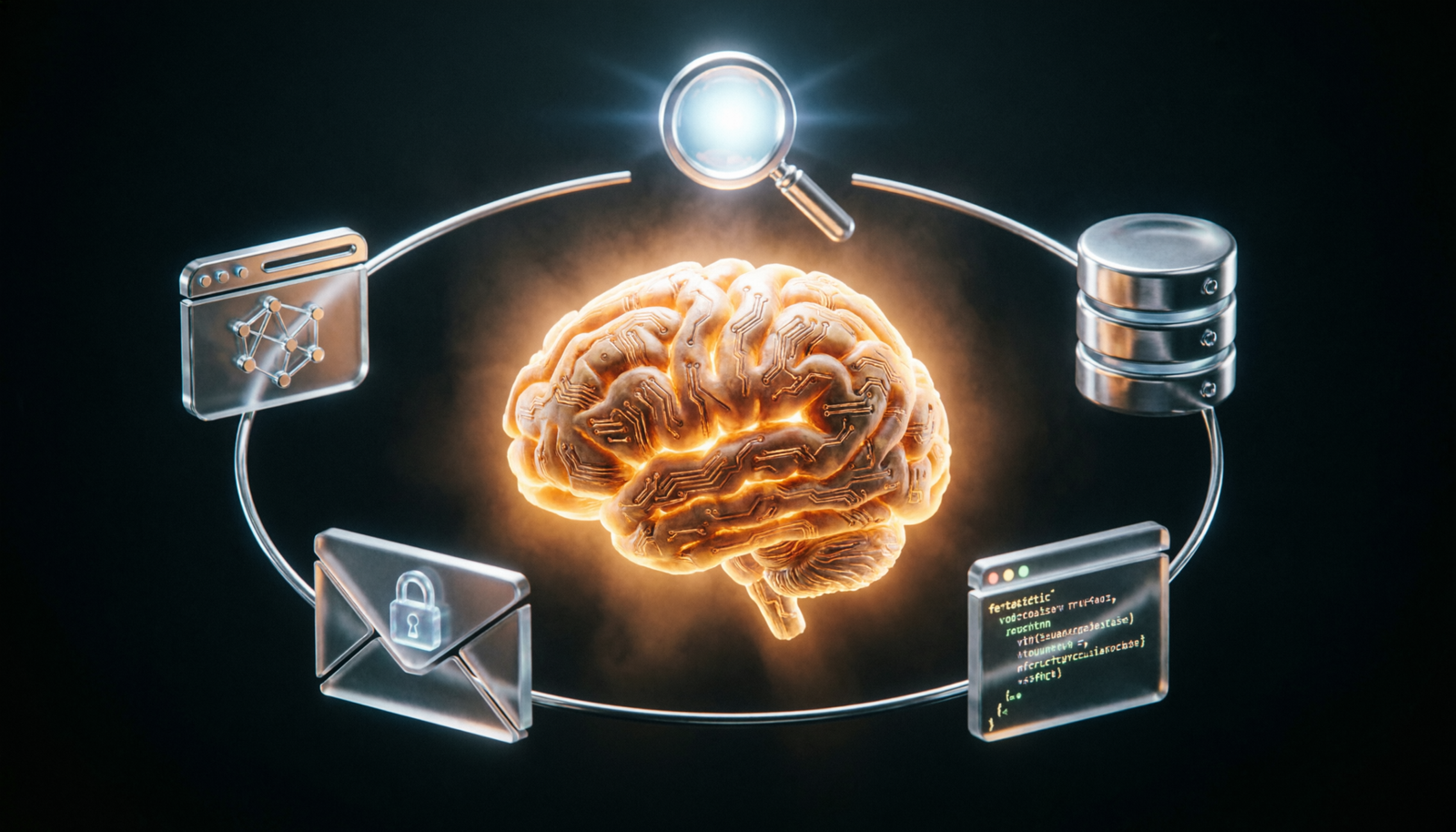
Think of an AI agent as having a brain (the language model), hands (tools and APIs), memory (context and storage), and a mission (the goal you give it).
Reasoning
Uses a large language model to interpret goals, break them into steps, and decide what to do next based on observations.
Tool Use
Calls APIs, runs code, searches the web, reads files, and interacts with external systems to gather information or take actions.
Autonomy
Operates across multiple steps without needing a human to approve every decision, looping until the goal is reached or clarification is needed.
Memory
Retains context across a session or even across sessions, learning from prior steps to inform future decisions.
How Agents Work
Observe
The agent receives a goal or task from the user and collects context from its environment — documents, databases, or web results.
Plan
Using its language model, the agent breaks the goal into sub-tasks and decides which tools to call or what action to take first.
Execute
The agent calls tools, writes code, makes API requests, or produces outputs — then feeds results back into its reasoning loop.
Evaluate
It checks whether the goal has been met. If not, it adjusts and loops back — asking for clarification if it’s stuck.
Real-World
Use Cases
Research & Analysis
Agents autonomously search the web, read papers, and synthesize findings into structured reports.
- Competitive intelligence gathering
- Literature review automation
- Market trend summarization
Software Engineering
Coding agents write, test, debug, and refactor code — spanning entire features or codebases.
- Bug triage and auto-fix PRs
- Test generation and CI pipelines
- Code migration across frameworks
Customer Support
Support agents understand queries, check CRM data, and resolve issues — escalating only when needed.
- Order tracking and refunds
- Personalized troubleshooting
- Multi-turn issue resolution
Data & Finance
Financial agents pull live data, run calculations, and generate insights or alerts automatically.
- Portfolio monitoring & alerts
- Automated report generation
- Anomaly detection in transactions
Workflow Automation
Agents connect SaaS tools, handle scheduling, file management, and repetitive office tasks.
- Email triage and drafting
- Calendar and meeting scheduling
- CRM data entry and enrichment
Science & Healthcare
Agents assist with clinical documentation, drug discovery pipelines, and biomedical research queries.
- Clinical note summarization
- Drug interaction lookup
- Genomic data exploration
Agent in Action
Scenario: A research agent asked to produce a competitive analysis report.
“Give me a competitive analysis of the top 5 cloud storage providers, including pricing, features, and recent news.”
Breaks goal into sub-tasks:
- Identify top 5 providers
- Search pricing pages for each
- Search for news in last 90 days
- Compare features across providers
- Write structured report
Calls web search tool 8 times, visits 12 URLs, extracts pricing tables, reads 5 news articles, stores all data in working memory.
Synthesizes findings into a structured report with a comparison table, key differentiators, and a recommended pick — all without human hand-holding.