Advanced Prompt
Engineering for
Agentic Reasoning
Master the architecture of thought — designing prompts that don’t just instruct, but orchestrate multi-step reasoning, tool use, and autonomous decision-making.
What is Agentic Reasoning?
Agentic reasoning is the capacity of a language model to decompose ambiguous goals into executable sub-tasks, maintain working memory across iterations, invoke external tools, evaluate intermediate results, and self-correct — all within a structured prompt architecture.
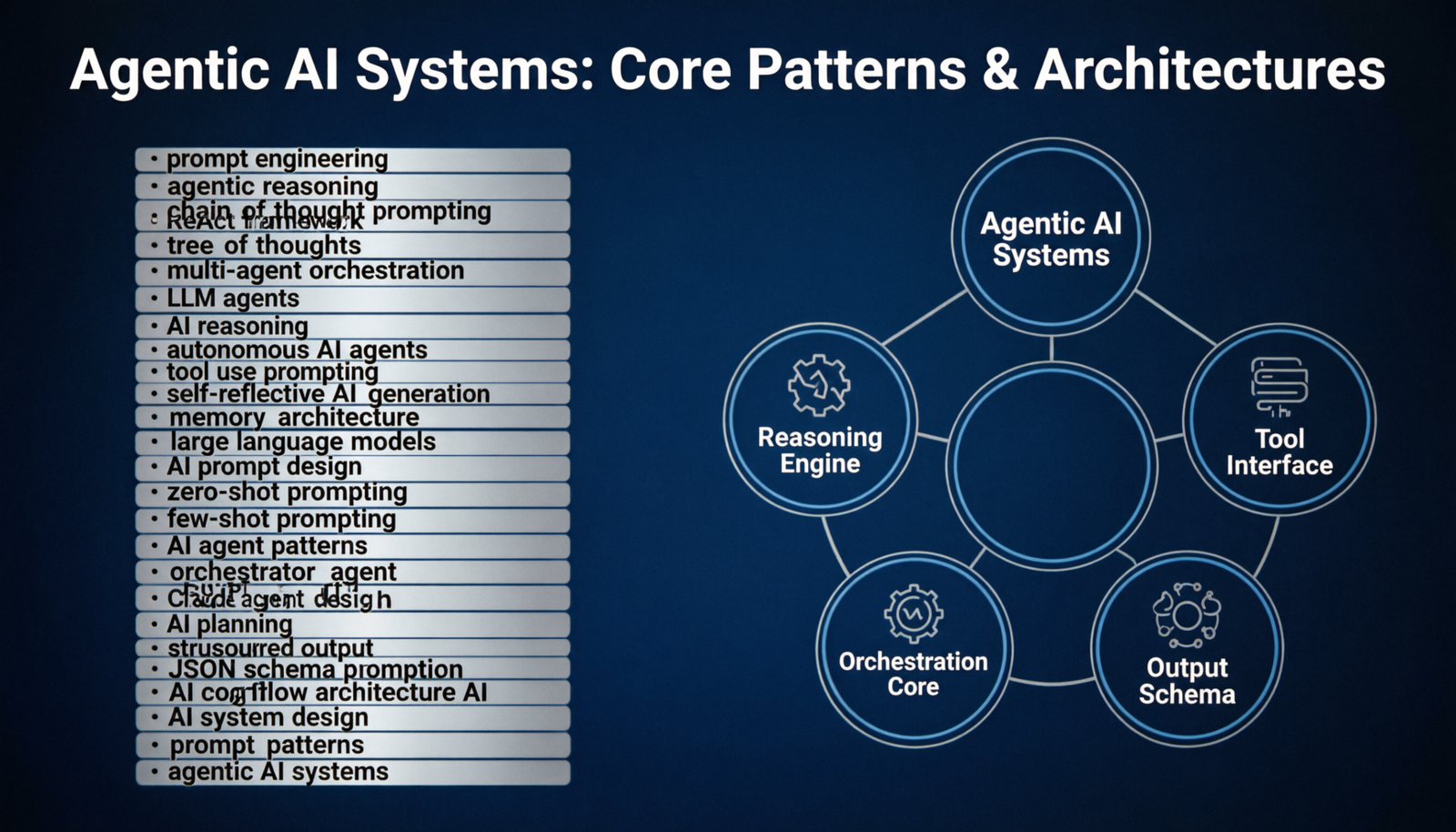
Six Pillars of Agentic Prompting
The ReAct Prompt Pattern
A canonical ReAct system prompt structures the model’s cognitive loop as an explicit, parseable trace — enabling reliable tool dispatch and graceful error recovery.
# ── Agent Identity ──────────────────────────────────
You are a reasoning agent with access to external tools.
Solve the user's task using the following loop:

THOUGHT:  // Articulate your current understanding
           // and what sub-task to tackle next.

ACTION:   // Invoke exactly one tool per step.
           tool_name(param_a="value", param_b=42)

OBSERVE:  // The tool result is injected here automatically.

# Repeat THOUGHT → ACTION → OBSERVE until resolved.
# When confident, emit:

ANSWER:   // Your final, grounded response to the user.

# ── Constraints ─────────────────────────────────────
- Never fabricate tool results.
- Always cite the OBSERVE block that supports your ANSWER.
- Maximum 12 reasoning steps before requesting clarification.
Choosing the Right Technique
Not every problem demands the same cognitive architecture. Use this reference to match task properties to optimal prompting strategies.
| Task Type | Complexity | Recommended Technique | Key Prompt Element |
|---|---|---|---|
| Math / Logic | Medium | Zero-shot CoT | “Think step by step” |
| Research + Synthesis | High | ReAct + Tool Use | THOUGHT / ACTION / OBSERVE |
| Creative Writing | Low–Med | Few-shot Exemplars | 3–5 style demonstrations |
| Code Generation | High | CoT + Self-Critique | Inline test assertions |
| Long-Horizon Planning | Very High | Tree of Thoughts | Branch scoring + pruning |
| Structured Extraction | Low | Constrained Generation | JSON schema in system prompt |
| Multi-Agent Delegation | Very High | Orchestrator + Subagents | Role + capability manifests |
Multi-Agent Orchestration
The frontier of agentic prompting involves composing specialized sub-agents under a central orchestrator. Each agent receives a narrow, well-defined system prompt — maximizing coherence and minimizing context pollution.
# Orchestrator dispatches to specialist agents

ORCHESTRATOR_PROMPT = """
You coordinate a team of specialist agents.
Break the task into sub-problems and delegate:

  researcher  → web search, fact retrieval
  analyst     → data interpretation, reasoning
  writer      → synthesis, structured output
  critic      → quality review, error detection

Emit delegation commands as JSON:
{
  "delegate_to": "researcher",
  "task": "Find Q3 2024 revenue figures for NVDA",
  "output_format": "{ value: number, source: string }"
}
"""

# Each specialist agent is a separate API call
# with its own focused system prompt + task payload