
Artificial Intelligence · Conceptual Primer
Discriminative
vs Generative
Models
Two philosophies of machine learning — one learns to decide, the other learns to create. Understanding the distinction unlocks how modern AI really works.
The Core Distinction
What separates them?
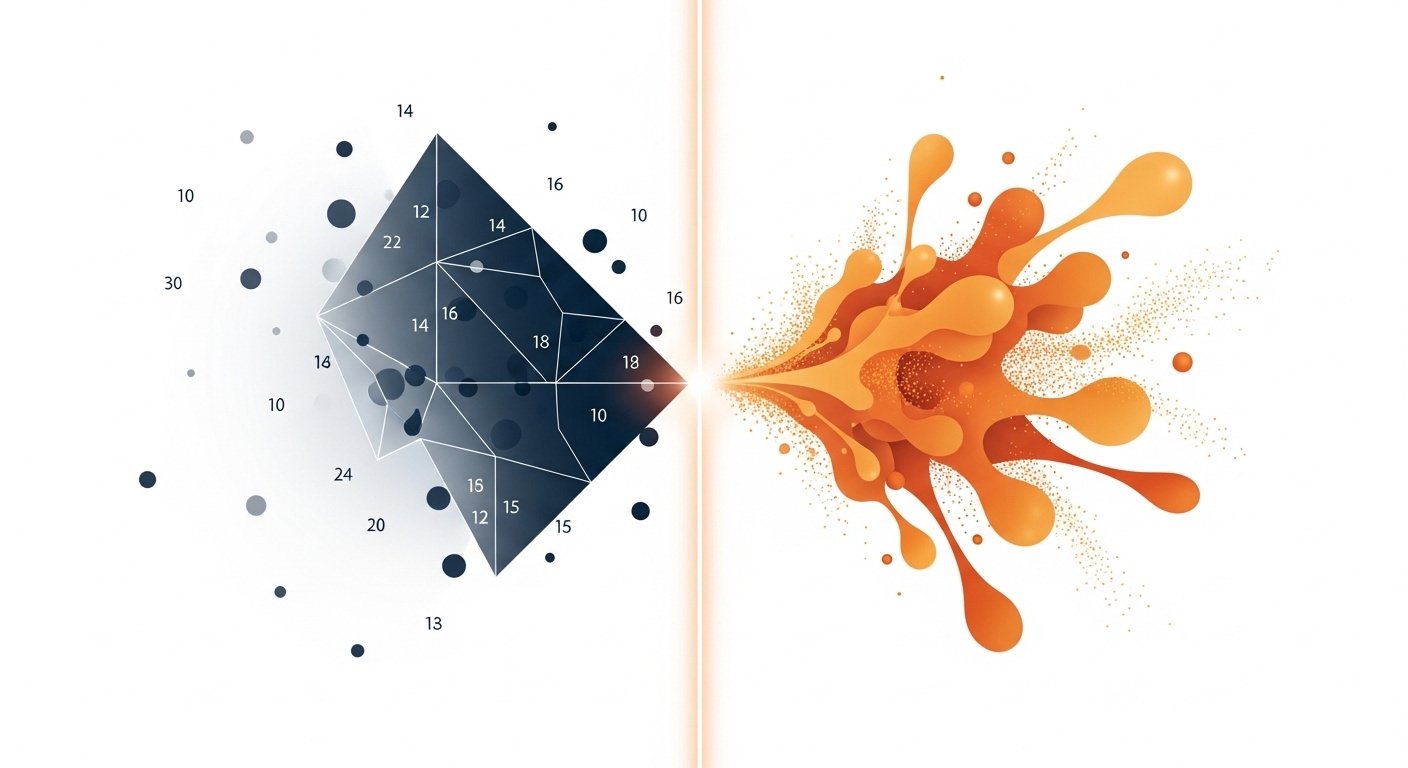
At the heart of machine learning lies a fundamental fork: should a model learn boundaries between things, or learn what things actually look like? This single question divides the entire landscape into two families.
“Discriminative models ask which box does this belong in? Generative models ask what does a member of this box look like?“
Learns the boundary
Models the conditional probability P(y | x) — given input x, what is the most likely label y? It draws decision boundaries directly in input space without ever modelling the data itself.
Learns the distribution
Models the joint probability P(x, y) or the data distribution P(x). By understanding the full landscape of what data looks like, it can classify — and also create.
Under the Hood
The probabilistic view
Both families ultimately deal in probability, but they model very different quantities. The math reveals why generative models are more powerful — and also harder to train.
Head to Head
Key distinctions at a glance
| Dimension | Discriminative | Generative |
|---|---|---|
| Primary goal | Classify or predict labels | Model the data distribution |
| What it learns | Decision boundary P(y | x) | Data density P(x) or P(x, y) |
| Can generate new data? | No | Yes |
| Typical training data need | Less — focuses on boundaries | More — must model everything |
| Handles missing features? | Poorly — requires full input | Naturally — can impute |
| Interpretability | Often higher for simple models | Varies; latent spaces complex |
| Training complexity | Generally lower | Generally higher |
| Outlier / anomaly detection | Indirect, less natural | Native via low-density regions |
Model Families
Recognisable examples
Nearly every model you’ve encountered falls into one of these two camps — sometimes models straddle both.
Classic examples
Logistic Regression · Support Vector Machines (SVMs) · Decision Trees · Random Forests · Conditional Random Fields (CRFs) · Traditional Neural Classifiers (e.g. ResNet for ImageNet)
Classic examples
Naïve Bayes · Hidden Markov Models · Variational Autoencoders (VAEs) · Generative Adversarial Networks (GANs) · Diffusion Models · Large Language Models (GPT, Claude)
Applications
Where each shines
Discriminative models excel at
Generative models excel at
The Bigger Picture
A spectrum, not a binary
Modern AI increasingly blurs the line. Discriminatively fine-tuned generative models (like instruction-tuned LLMs) combine both philosophies: they learn rich world representations generatively, then are steered toward specific tasks discriminatively. Semi-supervised and self-supervised methods use generative pretraining to supercharge discriminative downstream performance.
Understanding which regime a model operates in tells you what it fundamentally can and cannot do — making you a sharper practitioner regardless of the tools you reach for.
A conceptual overview · Concepts apply across supervised, unsupervised, and semi-supervised learning paradigms · 2025