
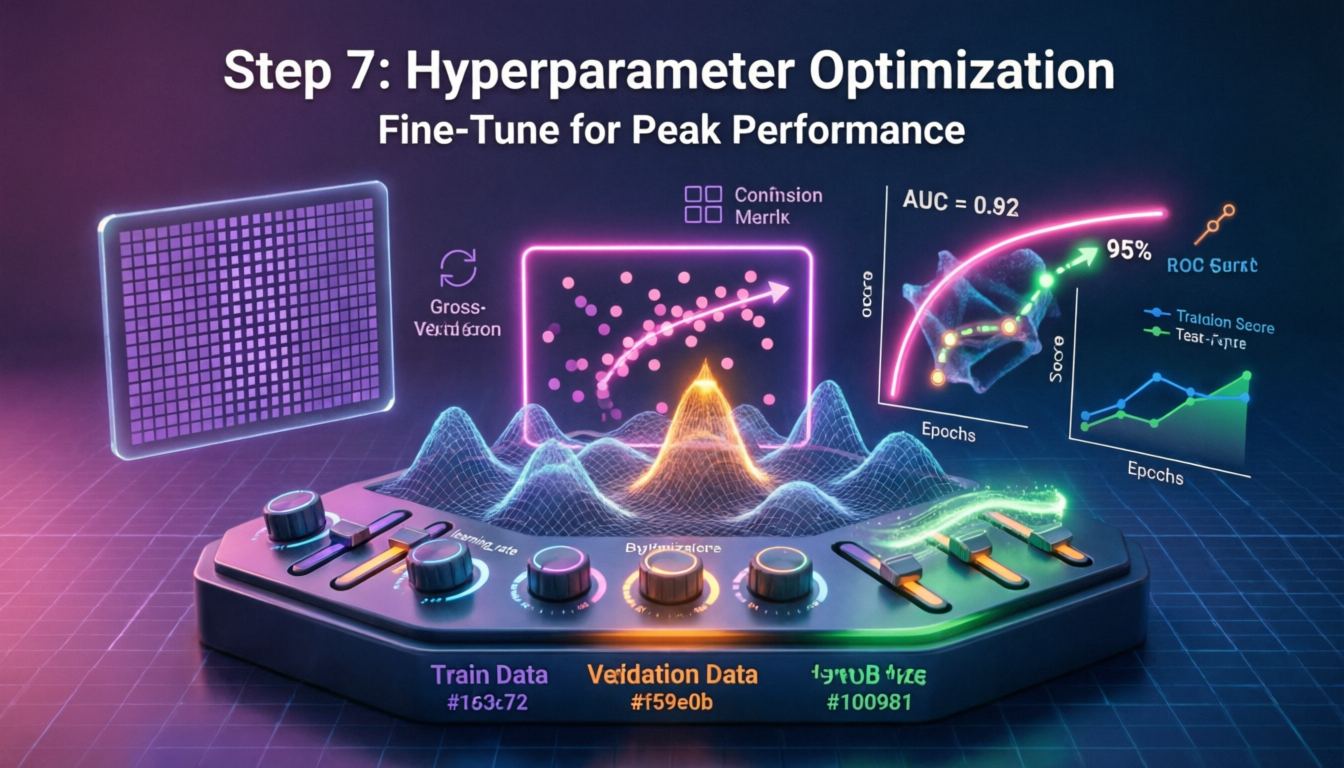
⚙️ Step 7: Hyperparameter Optimization
Fine-Tune Parameters to Improve Performance
🎯What is Hyperparameter Optimization?
Hyperparameters are configuration settings that control the learning process of a model. Unlike model parameters (learned from data), hyperparameters are set before training and significantly impact model performance.
Parameters: Learned during training (e.g., weights in neural networks)
Hyperparameters: Set before training (e.g., learning rate, number of trees, depth)
Why Optimize Hyperparameters?
- Can improve model performance by 5-20% or more
- Reduces overfitting and underfitting
- Helps models generalize better to unseen data
- Balances bias-variance tradeoff
- Optimizes training speed and efficiency
📋Common Hyperparameters by Algorithm
Random Forest
n_estimators
Number of trees in the forest
Range: 50-500
max_depth
Maximum depth of each tree
Range: 10-100 or None
min_samples_split
Min samples to split a node
Range: 2-20
min_samples_leaf
Min samples in a leaf node
Range: 1-10
max_features
Features to consider for splits
Values: 'sqrt', 'log2', None
Gradient Boosting (XGBoost/LightGBM)
learning_rate
Step size for weight updates
Range: 0.001-0.3
n_estimators
Number of boosting rounds
Range: 100-1000
max_depth
Maximum tree depth
Range: 3-10
subsample
Fraction of samples per tree
Range: 0.5-1.0
colsample_bytree
Fraction of features per tree
Range: 0.5-1.0
Neural Networks
learning_rate
Optimizer step size
Range: 1e-5 to 1e-2
batch_size
Samples per gradient update
Values: 16, 32, 64, 128
hidden_layers
Number and size of layers
Example: [128, 64, 32]
dropout_rate
Regularization dropout
Range: 0.1-0.5
optimizer
Optimization algorithm
Values: Adam, SGD, RMSprop
Support Vector Machines (SVM)
C
Regularization parameter
Range: 0.1-100
kernel
Kernel type
Values: 'linear', 'rbf', 'poly'
gamma
Kernel coefficient
Range: 0.001-1.0
🔍Hyperparameter Tuning Methods
1. Grid Search
Exhaustively searches through a manually specified subset of hyperparameter space.
✅ Pros
- Guaranteed to find best combination in search space
- Easy to implement and understand
- Parallelizable
- Reproducible results
❌ Cons
- Computationally expensive
- Time grows exponentially with parameters
- Wastes resources on poor regions
- Not suitable for large search spaces
Example: Grid Search with Scikit-learn
2. Random Search
Randomly samples from the hyperparameter space for a fixed number of iterations.
✅ Pros
- More efficient than grid search
- Better for high-dimensional spaces
- Can find good parameters quickly
- Explores diverse combinations
❌ Cons
- No guarantee of finding optimal
- May miss important regions
- Results vary between runs
- Need to set number of iterations
Example: Random Search with Scikit-learn
3. Bayesian Optimization
Uses probabilistic models to intelligently select the next hyperparameters to evaluate based on past results.
✅ Pros
- Most efficient for expensive evaluations
- Learns from previous iterations
- Balances exploration vs exploitation
- Requires fewer iterations
❌ Cons
- More complex to implement
- Sequential (harder to parallelize)
- Requires additional libraries
- Can get stuck in local optima
Example: Bayesian Optimization with Optuna
4. Successive Halving (HalvingGridSearch / HalvingRandomSearch)
Starts with many configurations on small data, progressively eliminates poor performers, allocating more resources to promising candidates.
✅ Pros
- Much faster than standard grid/random search
- Efficient resource allocation
- Good for large datasets
- Can handle more configurations
❌ Cons
- May eliminate good configs early
- Experimental in scikit-learn
- Requires more setup
- Less interpretable
Example: Successive Halving
🚀Advanced Optimization Techniques
Hyperband (via Optuna or Ray Tune)
Neural Architecture Search (NAS) with Keras Tuner
Genetic Algorithms with TPOT (AutoML)
📊Method Comparison
| Method | Speed | Efficiency | Best For | Complexity |
|---|---|---|---|---|
| Grid Search | ⭐ | ⭐ | Small search spaces, few parameters | Low |
| Random Search | ⭐⭐⭐ | ⭐⭐⭐ | Medium-large spaces, quick exploration | Low |
| Bayesian Optimization | ⭐⭐⭐⭐ | ⭐⭐⭐⭐⭐ | Expensive models, limited budget | Medium |
| Successive Halving | ⭐⭐⭐⭐⭐ | ⭐⭐⭐⭐ | Large datasets, many configurations | Medium |
| Hyperband | ⭐⭐⭐⭐⭐ | ⭐⭐⭐⭐⭐ | Neural networks, adaptive budgets | High |
| Genetic Algorithms | ⭐⭐⭐ | ⭐⭐⭐⭐ | Pipeline optimization, AutoML | High |
🔄Complete Optimization Workflow
Train model with default parameters and record performance
Identify important hyperparameters and reasonable ranges
Select based on time budget and search space size
Start with random search or Bayesian optimization
Examine parameter importance and interactions
Narrow range around best parameters, run focused search
Evaluate final model on held-out test data
Record final hyperparameters and performance metrics
Complete Example: End-to-End Optimization
✨Best Practices & Tips
1. Start Simple, Then Expand
Begin with a small number of key hyperparameters. Once you understand their impact, expand your search.
2. Use Logarithmic Scales for Learning Rates
Learning rates often work best on log scale (e.g., 0.001, 0.01, 0.1 rather than 0.001, 0.002, 0.003).
3. Always Use Cross-Validation
Evaluate hyperparameters with CV to get robust estimates and avoid overfitting to validation set.
4. Set a Time Budget
Hyperparameter optimization has diminishing returns. Set a reasonable time limit.
5. Monitor Overfitting During Tuning
Track both training and validation performance. Large gaps indicate overfitting.
6. Document Everything
Keep detailed records of all experiments, parameters, and results for reproducibility.
7. Use Early Stopping for Iterative Models
Stop training when validation performance stops improving to save time and prevent overfitting.
8. Consider Computational Cost
Balance performance gains against training time and computational resources.
⚠️Common Pitfalls to Avoid
❌ Using Test Set for Hyperparameter Tuning
Problem: Leads to overly optimistic performance estimates
Solution: Only use train + validation for tuning; test set for final evaluation only
❌ Too Many Hyperparameters at Once
Problem: Exponential growth in search space, wasted computation
Solution: Start with 3-5 most important parameters, then expand gradually
❌ Ignoring Domain Knowledge
Problem: Searching unrealistic parameter ranges
Solution: Use literature and documentation to set sensible ranges
❌ Not Fixing Random Seeds
Problem: Results not reproducible, hard to compare runs
Solution: Always set random_state/seed in models and search algorithms
❌ Optimizing Wrong Metric
Problem: High accuracy doesn’t mean good business outcomes
Solution: Choose metrics aligned with your actual objectives (F1, precision, recall, etc.)
🛠️Popular Tools & Libraries
Scikit-learn
GridSearchCV, RandomizedSearchCV, HalvingGridSearchCV
Best for: Traditional ML models
Optuna
Advanced Bayesian optimization framework
Best for: Any ML framework, highly customizable
Hyperopt
Bayesian optimization with TPE algorithm
Best for: Complex search spaces
Ray Tune
Scalable hyperparameter tuning for distributed systems
Best for: Large-scale experiments, deep learning
Keras Tuner
Hyperparameter tuning for Keras/TensorFlow
Best for: Neural architecture search
Weights & Biases
Experiment tracking with hyperparameter sweeps
Best for: Tracking and visualization